
Introduction
Starting a business, launching a product, or entering a new industry involves more than having a good idea. You also need to understand who might buy your product, what those customers need, how competitors serve them, and whether the opportunity is financially realistic. This is where market analysis becomes useful.
Market analysis is the process of studying a specific market to understand its customers, demand, size, competition, trends, and potential risks. It helps businesses make informed decisions about pricing, product development, marketing, expansion, and investment.
For example, someone planning to open a coffee shop should investigate local customer preferences, nearby competitors, average prices, foot traffic, and operating costs before signing a lease. A growing population might suggest an opportunity, but the business still needs enough paying customers to become profitable.
A good market analysis connects research with action. It does not simply collect statistics. It explains what those findings mean for a particular business and what the business should do next.
What Is Market Analysis?
Market analysis is a structured assessment of a defined market, including its size, customer groups, demand, competition, economic conditions, and future potential.
The goal is to determine whether a business opportunity is attractive, which customers are most likely to buy, and how a company can compete effectively.
Market analysis can be used by new businesses evaluating an idea, established companies considering expansion, marketing teams developing campaigns, and investors assessing commercial opportunities.
A typical analysis examines the following areas:
- Market size: How many potential customers exist, and what is the potential spending or revenue?
- Customer demand: What problems do customers need to solve, and how willing are they to pay for a solution?
- Target audience: Which customer groups are most relevant to the product or service?
- Competition: Which businesses already serve those customers, and what alternatives are available?
- Pricing: What do customers currently pay, and what price might they accept?
- Market trends: How are technology, consumer behavior, regulations, and economic conditions changing the market?
- Risks and opportunities: What could support or prevent business growth?
These factors help businesses evaluate opportunities using evidence rather than relying entirely on assumptions.
Why Is Market Analysis Important?
Market analysis helps reduce uncertainty before a business commits significant time or money to a decision. It cannot eliminate risk, but it can reveal weaknesses that might otherwise remain hidden.
1. Understand Customer Needs
Businesses need to know what customers actually want, not simply what the business assumes they want.
Interviews, surveys, customer reviews, and purchase data can reveal common complaints, preferred features, and unmet needs. These findings can help a company improve its offer or identify a more suitable audience.
2. Identify Business Opportunities
Research can reveal customer groups that competitors overlook, locations with unmet demand, or services that existing providers deliver poorly.
For example, customers might be satisfied with local restaurants but frustrated by slow delivery during lunch hours. A business could investigate whether a reliable delivery service would solve that problem at a price customers are willing to pay.
The opportunity must still be tested. A complaint does not automatically mean enough people will pay for a solution.
3. Evaluate Competitors
Understanding competitors helps businesses identify how to differentiate their products, services, prices, and customer experience.
A small business may not be able to compete with a large company on advertising budgets. However, it might compete through specialist knowledge, faster service, convenient opening hours, or a more focused product range.
4. Make Better Pricing Decisions
Market analysis provides context for setting prices. It helps businesses compare competing offers, understand customer budgets, and estimate whether a proposed price can cover costs.
The lowest price is not always the best choice. Customers may pay more for better quality, convenience, reliability, or specialist service.
5. Reduce Business Risk
Research can uncover barriers such as strong competition, weak demand, seasonal sales, regulatory requirements, or high customer acquisition costs.
Identifying these issues early allows a business to change its plan, test a smaller version of its idea, or decide not to proceed.
6. Support Business Planning
Market findings can inform sales forecasts, marketing budgets, product development, hiring, and expansion plans.
The Small Business Administration explains that market research helps businesses understand customers and demand, while competitive analysis helps them identify how to differentiate themselves from other providers. Its guidance is available through the SBA’s business planning resources.
Types of Market Analysis
The type of analysis depends on the decision a business needs to make. Several approaches are often combined in one assessment.
Industry Analysis
Industry analysis examines the wider business environment in which a company operates.
It may cover industry size, growth patterns, regulations, technology, supply chains, major companies, and economic conditions.
For example, a company considering electric vehicle accessories might examine vehicle adoption, charging infrastructure, consumer spending, and changes in vehicle technology.
Industry analysis provides context, but it does not automatically prove that a particular product will succeed.
Customer Analysis
Customer analysis focuses on the people or organizations most likely to purchase an offer.
It examines factors such as age, location, income, business size, buying habits, priorities, and purchasing barriers.
Businesses can use this information to build customer segments and develop more relevant products and marketing messages.
Competitor Analysis
Competitor analysis studies direct and indirect alternatives available to customers.
Direct competitors sell similar products to similar audiences. Indirect competitors solve the same problem in a different way.
For instance, a local gym competes directly with other gyms, but it may also compete indirectly with home workout equipment, fitness apps, and outdoor exercise groups.
A useful competitor review examines prices, product quality, customer feedback, distribution, service, and positioning.
Demand Analysis
Demand analysis estimates whether customers want a product or service and under what conditions they might buy it.
Useful indicators include customer inquiries, search interest, sales of comparable products, survey responses, repeat purchases, and the availability of substitutes.
Demand should be evaluated in relation to price and timing. Interest in a free product does not necessarily indicate willingness to purchase it.
Market Size and Opportunity Analysis
Market sizing estimates the potential scale of a business opportunity.
Businesses may calculate the number of potential customers, their expected spending, or the total annual revenue associated with a defined market.
A large market can be attractive, but its size alone does not establish that a particular company can reach customers or earn a profit.
Geographic Analysis
Geographic analysis compares opportunities across cities, regions, countries, or neighborhoods.
It can help a retailer choose a location, a service company prioritize delivery areas, or an online business decide which regions to target.
Population, income, local competition, transport, infrastructure, and relevant regulations may all affect the result.
Market Analysis vs. Market Research
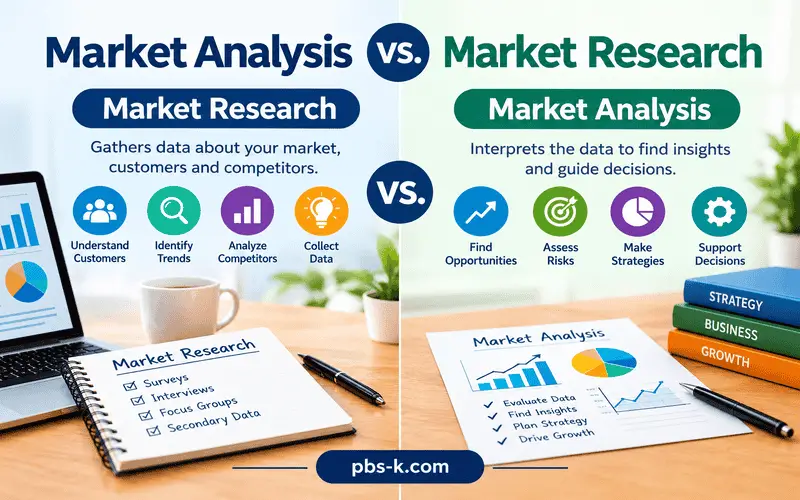
Market analysis and market research are closely related, but they are not exactly the same.
Market research is the process of collecting information about customers, competitors, and market conditions. Market analysis interprets that information to understand the opportunity and support a decision.
| Factor | Market Research | Market Analysis |
|---|---|---|
| Main purpose | Gather relevant information | Interpret evidence and assess the market |
| Typical activities | Surveys, interviews, data collection | Market sizing, competitor comparisons, trend assessment |
| Main output | Findings and collected data | Insights, risks, opportunities, and recommendations |
| Example | Ask customers which coffee flavors they prefer | Decide which flavors to sell based on preferences, costs, and competition |
In practice, the two activities overlap. A strong business plan usually needs both.
Research without analysis may produce a large amount of information without a clear conclusion. Analysis without reliable research may lead to decisions based on unsupported assumptions.
How to Conduct a Market Analysis Step by Step
A useful market analysis does not have to be complicated or expensive. The following process provides a practical starting point for small businesses and larger organizations alike.
Step 1: Define Your Objective
Start by identifying the decision you want the analysis to support.
Are you launching a new product, entering a different region, changing prices, evaluating competitors, or deciding whether to start a business?
A specific question makes the research more focused.
For example, instead of asking, “Is the food market profitable?”, ask, “Is there enough demand for a takeaway lunch service serving office workers within a three-mile radius?”
The second question identifies a customer group, a product, and a geographic area.
Step 2: Define Your Target Market
Describe the customers you intend to serve.
For a consumer product, relevant factors may include location, age range, income, lifestyle, preferences, and purchasing habits.
For a business-to-business product, consider industry, company size, location, budget, purchasing process, and the problem the product solves.
Avoid defining your audience as everyone who could theoretically use the product. A narrower, evidence-based target market often makes research and marketing more useful.
Step 3: Measure Market Size
Estimate how many potential customers fit your definition and how much they might spend.
Two common approaches are top-down and bottom-up market sizing.
Top-down approach: Start with a credible industry or market estimate and narrow it to the segment relevant to your business. This is useful for an initial overview, but the assumptions behind each reduction need to be explained.
Bottom-up approach: Estimate the number of customers you can serve and multiply that figure by expected spending or revenue per customer. This approach makes the assumptions easier to inspect and test.
For example, suppose a local cleaning business identifies 500 suitable households in its service area. If each household could reasonably purchase services worth $600 per year, the theoretical annual revenue for that group would be $300,000.
That figure is not a sales forecast. Some households will not need the service, some will choose competitors, and the business may not have enough staff to serve every customer.
For startups, three commonly used terms help separate different levels of opportunity:
- Total addressable market (TAM): The total potential market for the defined product or service.
- Serviceable available market (SAM): The portion the business can serve with its current product, location, and business model.
- Serviceable obtainable market (SOM): The portion the business could realistically capture over a specified period.
These estimates should be supported by credible data and clear assumptions. The UK government’s investor readiness guidance discusses evidence-based market sizing and the importance of realistic opportunity estimates.
Step 4: Research Customer Demand
Determine whether the target audience has a genuine need for your offer.
Useful methods include:
- Customer interviews: Explore problems, current solutions, and buying decisions.
- Surveys: Gather structured responses from a relevant group of potential customers.
- Existing customer data: Review sales, repeat purchases, returns, and customer complaints.
- Online reviews: Identify recurring strengths and weaknesses in competing products.
- Small-scale tests: Test a landing page, sample product, trial service, or limited campaign.
Ask questions that reveal actual behavior, not just opinions.
For example, “Would you buy a premium lunch service?” may produce overly positive responses. Asking what customers currently spend on lunch, how often they buy it, and what would make them switch can provide more useful evidence.
Whenever possible, compare stated interest with actual actions, such as purchases, trial sign-ups, or paid reservations.
Step 5: Analyze Your Competitors
Identify the businesses that compete for the same customers, including indirect alternatives.
Create a simple comparison of three to five relevant competitors.
| Factor | What to Investigate |
|---|---|
| Products and services | What do they offer, and what is missing? |
| Pricing | What do customers pay, including extra fees? |
| Target audience | Which customers do they focus on? |
| Customer experience | What do reviews reveal about service quality? |
| Marketing | Which channels and messages do they use? |
| Strengths | What do customers value about them? |
| Weaknesses | Where are customers dissatisfied? |
Use public information, product demonstrations, published pricing, customer reviews, and other legitimate sources.
Do not assume a competitor is weak because it has a few negative reviews. Look for repeated patterns across multiple sources and consider how representative the feedback may be.
The purpose is not simply to copy competitors. It is to identify where your business can offer meaningful value.
Step 6: Examine Market Trends
Study changes that may affect demand or competition.
Relevant trends might include shifts in consumer preferences, new technology, population changes, inflation, employment, environmental requirements, and industry regulation.
Separate long-term structural changes from temporary events. A short-lived increase in search interest, for example, may not support a permanent business investment.
Whenever possible, compare several periods and consult reliable sources rather than basing a conclusion on one headline or social media post.
Step 7: Evaluate Pricing and Profit Potential
Compare the price customers pay for alternatives with the price you intend to charge.
Then consider your costs, including materials, labor, distribution, marketing, rent, payment processing, and customer support.
For example, if a product sells for $40 and its direct costs are $24, the gross profit per unit is $16 before other expenses. The gross margin is 40%.
This does not mean the business earns a 40% net profit. Operating expenses, taxes, and other costs still need to be considered.
A market can have strong demand but still be unattractive if competition forces prices too low or the cost of serving customers is too high.
Step 8: Identify Risks and Opportunities
Summarize the most important findings.
A SWOT analysis can help organize them into four categories:
- Strengths: Internal advantages, such as specialist expertise or a strong existing customer base.
- Weaknesses: Internal limitations, such as limited funding or low brand awareness.
- Opportunities: External conditions that may support growth, such as an underserved segment.
- Threats: External risks, such as aggressive competitors, changing regulations, or rising costs.
Keep internal factors separate from external ones. For example, limited staff is generally an internal weakness, while a new competitor entering the market is an external threat.
Prioritize the issues most likely to affect the decision rather than listing every possible factor.
Step 9: Turn Findings Into a Decision
Finish with a clear recommendation.
Depending on the evidence, you might decide to:
- Proceed with the original plan.
- Test a smaller product or customer segment first.
- Change the pricing or distribution strategy.
- Conduct more research on an unresolved issue.
- Delay expansion until important risks are addressed.
- Abandon the idea if the evidence does not support it.
A practical report should explain the recommendation, supporting evidence, assumptions, major risks, and next steps.
It should also identify what new information would change the decision. This makes the analysis useful even when the available data is incomplete.
Market Analysis Example for a Small Business
Consider a fictional entrepreneur planning to launch a mobile car-cleaning service in a suburban area.
The entrepreneur wants to know whether the service is worth testing before investing in a vehicle, equipment, and advertising.
1. Define the Market
The target customers are busy households and professionals who own cars but have limited time to visit a car wash.
The proposed service offers scheduled cleaning at customers’ homes or workplaces.
2. Collect Evidence
The entrepreneur reviews local competitors, compares service prices, interviews potential customers, and investigates the number of suitable households in the service area.
The research also examines travel time, water access, equipment costs, and local requirements.
3. Estimate the Opportunity
For illustration, suppose the entrepreneur identifies 400 potentially suitable households and estimates that 100 might become regular customers.
If each customer purchases a service worth $30 twice a month, the potential monthly revenue from those 100 customers would be:
100 customers × 2 services × $30 = $6,000.
This is a hypothetical revenue scenario, not evidence that 100 customers will sign up. Actual results depend on conversion rates, customer retention, capacity, competition, and operating costs.
4. Identify the Competitive Advantage
The research suggests that some customers value convenience more than the lowest price.
The entrepreneur could differentiate the service through reliable appointment times, transparent packages, and easy online booking rather than competing only on price.
5. Test Before Investing Heavily
The entrepreneur could begin with a small pilot, using suitable existing equipment and a limited service area.
The test should measure paid bookings, repeat purchases, travel time, customer acquisition costs, and profit per appointment.
If the pilot attracts paying customers and produces sustainable unit economics, the entrepreneur can consider expanding. If demand is weak, the results can guide changes before more money is committed.
The main lesson is that market analysis should test a business hypothesis, not merely confirm an existing belief.
Primary and Secondary Market Research Methods
Market analysis relies on two broad sources of information.
Primary Research
Primary research involves collecting new information directly from relevant people or observing actual behavior.
Examples include customer interviews, surveys, focus groups, product tests, and feedback from sales conversations.
Advantages:
- Can address a specific business question.
- Provides direct insight into customer preferences.
- Can uncover needs that published reports do not discuss.
Limitations:
- May require time, money, and careful planning.
- Poorly designed questions can produce misleading results.
- Small or unrepresentative samples may not reflect the wider market.
Secondary Research
Secondary research uses information that has already been collected or published.
Examples include government statistics, industry reports, company filings, trade publications, academic studies, and published economic data.
Advantages:
- Often faster and less expensive than collecting new data.
- Helps establish industry context and market trends.
- Can provide large datasets for comparisons.
Limitations:
- Information may be outdated or based on a different market definition.
- Some reports are expensive or have unclear methodologies.
- Broad industry data may not answer a specific customer question.
The strongest approach often combines both methods. Use existing data to understand the wider market, then collect targeted customer evidence to investigate the questions that remain.
Useful Market Analysis Tools and Data Sources
You do not necessarily need expensive software to conduct an initial market analysis. The right tools depend on your market, budget, location, and research question.
Government Statistics
Government datasets can help estimate population, income, employment, business counts, and other relevant indicators.
For example, the U.S. Census Bureau’s business data resources explain how businesses can use demographic and business information to study target customers and competition.
For UK research, the Office for National Statistics provides economic, population, and labor market statistics.
For research in Pakistan, the Pakistan Bureau of Statistics is a useful starting point for official national statistics. Always check whether the available dataset covers your specific region, industry, and target audience.
Google Trends
Google Trends helps users explore how search interest changes over time and compare interest across locations or topics.
It can be useful for identifying seasonal patterns and generating research questions.
However, Google Trends uses normalized search-interest data. Its values are not direct counts of searches, product sales, or customer demand.
Spreadsheet Software
Tools such as Microsoft Excel and Google Sheets can organize competitor prices, survey responses, market-size calculations, and financial scenarios.
A simple spreadsheet can include columns for the source, date collected, assumption, estimate, confidence level, and business implication.
This helps keep calculations transparent and makes it easier to update the analysis.
Survey and Customer Feedback Tools
Survey platforms and customer feedback systems can help gather information about preferences, satisfaction, and purchase intentions.
The quality of the results depends on the questions, sample selection, response rate, and how honestly respondents answer.
Do not treat a survey of a few friends or existing customers as representative of an entire market.
Industry and Competitor Sources
Company websites, public price lists, product catalogs, industry associations, business registries, and credible trade publications can help explain competitive conditions.
Before using a commercial market report, check its publication date, geographic coverage, definition of the market, methodology, and whether its estimates are independently verifiable.
Common Market Analysis Mistakes to Avoid
Even a well-organized report can produce poor decisions if the evidence is misunderstood.
Assuming a Large Market Guarantees Success
A large industry may contain many customers who have no need for your particular offer.
Define the segment you can actually serve and estimate realistic demand before making major investments.
Relying on Unsupported Assumptions
Statements such as “everyone wants this product” or “we only need 1% of the market” are not substitutes for evidence.
Explain how customer numbers, prices, conversion rates, and revenue estimates were calculated.
Ignoring Indirect Competitors
Customers often solve problems without buying the exact product you intend to sell.
Consider substitutes, do-it-yourself options, existing habits, and the possibility that customers may decide not to spend money at all.
Using Outdated Data
Markets change. Old information may no longer reflect current prices, regulations, customer preferences, or competitive conditions.
Record publication dates and verify important findings before relying on them.
Confusing Interest With Purchasing Intent
People may say that they like an idea without being willing to pay for it.
Use interviews to understand the problem, then test actual behavior through trials, paid orders, or other suitable methods.
Ignoring Costs and Operational Limits
A product can attract customers without generating a sustainable profit.
Evaluate delivery costs, staffing, inventory, customer support, capacity, and customer acquisition costs alongside market demand.
Treating the Analysis as a One-Time Task
Customer preferences, competitors, and economic conditions change over time.
Review the most important assumptions regularly and update the analysis when new evidence becomes available.
How to Present a Market Analysis Report
A market analysis report should be easy for another person to understand, verify, and use.
A practical report can contain these sections:
- Executive summary: The main findings and recommended decision.
- Objective and scope: The business question, product, geography, and time period.
- Market overview: Industry conditions, market size, and important trends.
- Target customers: Customer segments, needs, behavior, and buying barriers.
- Competitive landscape: Main competitors, alternatives, prices, and differentiation.
- Demand and pricing: Evidence of customer interest and willingness to pay.
- Risks and opportunities: Major uncertainties, limitations, and potential advantages.
- Financial implications: Revenue scenarios, relevant costs, and profitability considerations.
- Recommendation: What the business should do next and why.
- Sources and assumptions: Data references, calculation methods, collection dates, and limitations.
The report does not need to be long. Its purpose is to communicate the evidence and support a decision, not to include every fact discovered during research.
FAQs
What Is Market Analysis?
Market analysis is the process of studying a market’s size, customers, demand, competition, pricing, and trends. Businesses use it to evaluate opportunities, identify risks, and make informed decisions about products, marketing, and growth.
What Are the Main Types of Market Analysis?
The main types include industry analysis, customer analysis, competitor analysis, demand analysis, market sizing, and geographic analysis. Businesses often combine several types to understand a market more completely.
How Do You Conduct a Market Analysis?
Start by defining your business objective and target market. Then estimate market size, research customer demand, analyze competitors, examine trends, evaluate pricing and costs, and identify risks. Finish with a recommendation supported by evidence.
What Is the Difference Between Market Analysis and Market Research?
Market research involves collecting information about customers, competitors, and market conditions. Market analysis interprets that information to identify opportunities, assess risks, and guide business decisions. The two activities work together.
Why Is Market Analysis Important for a Small Business?
It helps small businesses understand customer needs, evaluate competition, choose suitable prices, and avoid investing heavily in ideas with weak demand. It can also reveal opportunities to serve a specific customer group more effectively.
What Are the Best Tools for Market Analysis?
Useful options include government statistical databases, Google Trends, spreadsheets, survey platforms, company websites, and industry reports. The best tools depend on the research question, available budget, market, and quality of the underlying data.
What Is the Difference Between TAM, SAM, and SOM?
TAM represents the total potential market for a defined product or service. SAM is the portion the business can serve with its offering and business model. SOM is the portion it could realistically capture within a defined period.
Can Market Analysis Guarantee Business Success?
No. Market analysis can reduce uncertainty and improve decision-making, but it cannot guarantee sales or profitability. Results depend on factors such as execution, competition, pricing, customer behavior, costs, and changes in market conditions.
How Often Should a Business Conduct Market Analysis?
A business should review its market assumptions regularly and conduct a more detailed analysis when making significant decisions, such as launching a product, entering a new region, changing prices, or responding to major competitive changes. The appropriate frequency depends on how quickly the market changes.
Conclusion
Market analysis gives businesses a practical way to evaluate customer demand, understand competitors, estimate market opportunities, and identify potential risks. By combining reliable data with customer research and realistic financial assumptions, businesses can make more informed decisions before committing resources.
For the best results, begin with a specific business question, verify your information, and turn your findings into an actionable plan. Market analysis cannot remove every uncertainty, but it can help you determine which opportunities deserve further testing and investment.
External Sources
Best for demographic and business statistics. Offers data that can help businesses examine local populations, customer characteristics, and competing businesses. Explore small business data resources
Office for National Statistics. Best for UK economic and population data. Useful for researching demographic changes, employment, economic indicators, and other factors affecting markets. Visit the ONS website