
Introduction
If you are researching the average cost reputation management services charge, there is no single price that applies to every business. The amount can range from relatively inexpensive software and self-managed tools to several thousand dollars per month for professional reputation repair.
A useful starting point is this: basic reputation monitoring or review-management tools can cost hundreds of dollars per month or less, while professional search-result repair commonly starts in the low thousands per month and can become much more expensive for complex cases. Published provider pricing illustrates just how wide the market is. For example, ReputationDefender currently lists local review-management configurations at $2,000 and $3,500 per year, while Reputation X publishes reputation repair services starting at $3,000 per month and more complex campaigns at higher levels.
The important point is that “reputation management” can describe very different services.
Managing 20 Google reviews for a local business is not the same job as trying to reduce the visibility of a damaging news article on Google’s first page. The price should reflect that difference.
How Much Does Reputation Management Cost?
For practical budgeting, the following ranges can help:
| Type of Reputation Management | Typical Budget Range | What It May Include |
|---|---|---|
| DIY reputation management | $0 to $100+ per month | Manual monitoring, responses, basic tools |
| Reputation monitoring software | Around $100 to $500+ per month | Mentions, reviews, alerts, reporting |
| Local review management | Around $150 to $1,000+ per month | Review monitoring, responses, review requests |
| Managed small-business ORM | Around $500 to $2,500+ per month | Reviews, listings, monitoring, content and strategy |
| Search-result reputation repair | Around $3,000 to $10,000+ per month | SEO, content, suppression strategy and monitoring |
| Complex or enterprise ORM | $10,000+ per month | Multi-market, multi-platform, crisis or high-authority campaigns |
These are budgeting ranges, not an industry-wide official price list. Reputation management providers price services differently, and some do not publish rates at all.
For example, Status Labs says its campaigns can range from a few thousand dollars per month to well into six figures for highly complex engagements. Reputation X currently lists search-engine-result repair from $3,000 per month, with higher packages starting at $5,000 and $10,000 per month.
That variation is why asking for the “average” price without defining the problem can produce a misleading answer.
What Does Reputation Management Include?
Reputation management is a broad category. A provider may offer one service or combine several.
Common services include:
- Monitoring online mentions
- Monitoring Google and other reviews
- Responding to customer reviews
- Developing a review-request process
- Managing business listings
- Creating positive or neutral content
- SEO for branded searches
- Improving existing website content
- Building authoritative third-party coverage
- Monitoring social media mentions
- Managing negative search results
- Reputation crisis support
- Executive or personal reputation management
- Monitoring how a brand appears in AI-powered search experiences
Google itself recommends responding to customer reviews because replies show customers that the business values their feedback. Google also allows businesses to report reviews that violate its policies, although simply disagreeing with a negative review is not grounds for removal.
Because these services require very different amounts of labor, they can have very different prices.
Reputation Management Cost by Service Type
Reputation Monitoring
Monitoring is generally the least complicated type of reputation management.
A monitoring service may track:
- Brand mentions
- Company names
- Executive names
- Reviews
- News coverage
- Social media mentions
- New search results
The business receives alerts or reports rather than having an agency actively repair every problem.
This can make monitoring a reasonable option for a company with a healthy reputation that wants early warning when something changes.
Review Management
Review management focuses primarily on customer feedback.
It may include:
- Monitoring review platforms
- Sending legitimate review requests
- Responding to reviews
- Identifying policy-violating reviews
- Reporting eligible reviews
- Tracking rating changes
- Generating reports
Published pricing gives some indication of the possible cost. ReputationDefender, for example, lists its Defender Local configurations at $2,000 and $3,500 annually, which works out to roughly $167 and $292 per month when averaged across 12 months.
However, multi-location businesses can spend considerably more because each location creates additional monitoring and management requirements.
Search Result Reputation Repair
This is usually much more expensive.
The objective may be to improve what appears when someone searches for:
- A company name
- A person’s name
- A product
- A specific executive
- A branded service
- A reputation-related search query
A campaign can involve SEO, content creation, digital PR, publisher outreach, technical optimization, monitoring and long-term content development.
Reputation X currently publishes search-result repair packages beginning at $3,000 per month, with higher packages beginning at $5,000 and $10,000 per month.
This does not mean every business needs to spend $3,000 per month. A company with a clean search profile may need only monitoring and review management.
Personal Reputation Management
Executives, professionals, public figures and other individuals can have different needs from local businesses.
A personal reputation campaign might involve:
- Name-based search results
- Professional profiles
- Biography pages
- News coverage
- Social media
- Personal websites
- Search-result content
- Privacy-related concerns
The cost depends heavily on what appears in search results and how authoritative those pages are.
A single low-authority page can be a relatively contained problem. A high-profile news story appearing prominently across search results can require considerably more work.
Why Reputation Management Prices Vary So Much
The biggest mistake when comparing reputation management quotes is assuming that two businesses with the same number of employees should pay similar prices.
They may not.
Number of Negative Results
One negative result is usually easier to address than five or ten.
If a negative article appears near the bottom of the first page, the strategy may require strengthening several relevant positive or neutral assets.
If multiple negative pages dominate the top positions, considerably more work may be necessary.
Ranking Position
Where the negative result appears matters.
A page ranking number 10 presents a different challenge from a page ranking number one.
The closer a negative result is to the top of the search results, the more difficult it may be to compete with it.
Authority of the Negative Website
The website publishing the negative information also matters.
A complaint on a small website and a highly authoritative news publication are not equivalent SEO problems.
High-authority publications can be difficult to outrank because they may have strong backlinks, established domains and substantial visibility.
Number of Search Terms
Some campaigns focus on one branded search.
Others need to address:
- Brand name
- Brand name reviews
- Executive name
- Product searches
- Location searches
- Negative phrase searches
- Multiple languages
More search terms generally mean more research, content and monitoring.
Number of Platforms
A problem limited to Google reviews is different from a reputation issue appearing across Google, social media, review websites, news publications and forums.
Each platform may require its own approach.
Industry
Certain industries naturally require greater attention to reputation because customers place significant trust in providers.
Examples can include:
- Healthcare
- Financial services
- Legal services
- Real estate
- Professional services
- Hospitality
- Education
This does not automatically mean every company in these sectors needs expensive ORM. It means the consequences of reputation problems may justify closer monitoring.
Speed Requirements
A business experiencing a sudden reputation crisis may want immediate support.
Urgent work can require additional personnel, monitoring and communications resources.
A proactive campaign that develops gradually usually provides more time for planning.
Is Reputation Management a Monthly Cost?
Often, yes.
Many professional ORM campaigns use monthly retainers because reputation improvement is not necessarily a one-time task.
A monthly engagement can cover:
- Monitoring
- Content creation
- SEO work
- Review management
- Reporting
- Strategy adjustments
- Ongoing optimization
Some providers also offer one-time projects.
For example, Reputation X publishes one-time options for certain Knowledge Panel services while separately offering monthly search-result repair and ongoing management services.
The right pricing model depends on the problem.
A one-time cleanup may make sense when a specific project has a clear beginning and end. Ongoing monitoring makes more sense when the business wants continued protection.
How Much Does DIY Reputation Management Cost?
DIY reputation management can cost very little in direct fees.
A small business can begin with:
- Searching its business name.
- Checking Google Business Profile.
- Reviewing major third-party review websites.
- Monitoring social mentions.
- Responding professionally to legitimate criticism.
- Reporting reviews that actually violate platform rules.
- Asking genuine customers for honest reviews.
- Improving website content and business information.
The financial cost may be low, but the time cost can become significant.
A business owner managing several locations may spend hours each week checking reviews and responding to customers.
That is where professional software or an agency can become useful.
Can You Remove a Negative Google Review?
Sometimes, but not simply because it is negative.
Google says businesses can report reviews that violate its policies. Reviews that do not violate the policies generally cannot be removed just because the business dislikes them. Google specifically notes that negative reviews can provide useful feedback and are not automatically grounds for removal.
Google’s prohibited-content rules include fake engagement, paid reviews, rating manipulation and other forms of misleading activity.
A legitimate reputation-management strategy should therefore distinguish between:
A genuine negative review: Respond professionally and address the underlying customer issue.
A policy-violating review: Report it through the appropriate platform process.
A false but policy-compliant review: Document the issue, respond carefully and consider appropriate business or legal advice when warranted.
Promising that every negative review can be removed is a major warning sign when evaluating a provider.
Why Fake Reviews Are a Bad Reputation Strategy
Buying positive reviews may look cheaper than legitimate reputation management, but it creates substantial risks.
The Federal Trade Commission’s Consumer Reviews and Testimonials Rule addresses deceptive review practices, including fake or false reviews, buying reviews conditioned on a particular sentiment, certain undisclosed insider testimonials and certain review suppression practices. The FTC also states that reputation-management companies and similar service providers can be liable for prohibited conduct.
Google separately prohibits paid reviews and other forms of fake engagement. Businesses that violate Google’s fake-engagement policies can face restrictions on their Business Profiles, including temporary limitations on receiving reviews or warnings to consumers.
The safer approach is simple: build a reputation from genuine customer experiences.
What Should a Reputation Management Quote Include?
Before accepting a proposal, ask the provider to explain exactly what you are buying.
A useful proposal should identify:
- Current reputation problems
- Search terms being monitored
- Platforms being monitored
- Services included
- Content creation volume
- Review-management responsibilities
- SEO activities
- Reporting frequency
- Expected campaign duration
- Client responsibilities
- Setup fees
- Monthly fees
- Additional costs
- Cancellation terms
- Measurement methods
Avoid proposals that simply say “we will improve your reputation” without explaining the work involved.
A transparent scope makes it much easier to compare providers.
Questions to Ask Before Hiring an ORM Agency
Ask these questions before signing a contract:
What Exactly Will You Do?
A reputable provider should be able to describe its strategy without hiding behind vague language.
Can You Guarantee Removal?
Be cautious about guarantees.
A provider cannot normally control another website or guarantee that Google will rank particular pages in specific positions.
Reputation X, for example, explicitly states that ethical ORM firms cannot guarantee specific search-engine rankings because search algorithms are controlled by third parties.
How Do You Handle Negative Reviews?
Ask whether the agency:
- Responds to them
- Reports only policy violations
- Requests legitimate customer feedback
- Uses review-management software
- Attempts inappropriate suppression
Do You Buy Reviews?
The answer should be no.
Google requires reviews to represent genuine experiences and prohibits incentives tied to reviews or changes to reviews.
What Are the Contract Terms?
Check:
- Minimum commitment
- Cancellation policy
- Setup fees
- Content ownership
- Reporting
- Extra charges
- Renewal terms
A low monthly price can become expensive if the contract includes a long commitment or substantial additional fees.
How to Decide What You Should Spend
Instead of starting with a price, start with the problem.
Consider these three questions:
1. Is my reputation currently healthy?
If yes, monitoring and proactive review management may be enough.
2. Do I have a moderate review or search problem?
A managed local reputation program may make sense.
3. Is damaging content dominating branded search results?
Professional ORM or SEO-based reputation repair may be justified.
This approach prevents a common mistake: paying for an expensive crisis-repair service when the business only needs routine monitoring.
A Simple Reputation Management Budget Example
Imagine a small local business with a strong website, one Google Business Profile and a few dozen reviews.
The company discovers that it has several unanswered reviews but no major negative search results.
It may not need an expensive search-suppression campaign.
A reasonable plan could involve:
- Review monitoring
- Professional review responses
- A legitimate customer-review request process
- Business-profile optimization
- Basic brand monitoring
- Monthly reporting
Now consider a different company with three negative articles ranking prominently for its brand name.
That problem requires a different strategy.
The company may need:
- Search-result analysis
- SEO research
- Content development
- Digital PR
- Third-party publishing
- Technical optimization
- Continuous monitoring
The second campaign can cost thousands of dollars per month because it involves substantially more work.
How to Calculate Whether ORM Is Worth the Cost
There is no universal ROI formula, but you can build a simple business case.
Start with:
Estimated lost customers × average customer value = potential revenue exposure
For example, suppose a company believes its reputation problem is costing 10 customers per month and each customer is worth $500.
That represents:
10 × $500 = $5,000 in monthly potential revenue
This does not prove that a $5,000 ORM campaign will generate $5,000 in additional revenue. It simply gives the business a starting point for comparing the potential financial impact of the problem with the proposed investment.
Also consider less obvious costs, such as:
- Lost leads
- Lower conversion rates
- Recruiting difficulties
- Customer-service time
- Sales objections
- Lost partnerships
- Management time
ReputationDefender notes that the cost of addressing a reputation problem should be evaluated against the potential business impact rather than against an arbitrary industry price.
Reputation Management vs. SEO
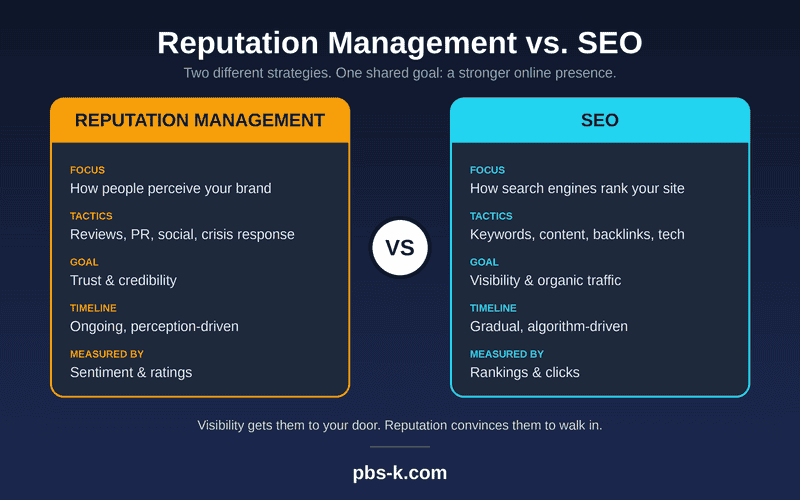
These services overlap, but they are not identical.
SEO generally focuses on improving visibility for relevant search queries and driving organic traffic.
Reputation management focuses more specifically on how a person, company or brand is represented online.
ORM can use SEO techniques, but it may also involve:
- Review management
- Digital PR
- Content strategy
- Social monitoring
- Crisis communications
- Brand monitoring
A company may therefore need both SEO and reputation management.
Reputation Management in the Age of AI Search
Reputation management is increasingly broader than traditional Google results.
People can now use AI-powered search and conversational systems to research companies, products and individuals.
This creates another consideration for modern ORM strategies: what information about a brand is being surfaced and summarized by AI systems?
Some providers now include generative engine optimization, or GEO, in reputation-management campaigns. Status Labs, for example, describes AI search exposure as a growing part of modern reputation work.
However, businesses should be cautious about claims that an agency can directly control what an AI system says. AI outputs depend on external information, model behavior and changing systems.
A responsible provider should discuss monitoring and improving the underlying information ecosystem rather than promising guaranteed AI responses.
Common Reputation Management Pricing Mistakes
Choosing the Cheapest Provider
Price matters, but it should not be the only factor.
An extremely cheap service may provide little more than automated monitoring.
Paying for Services You Do Not Need
A business with a healthy search profile may not need an expensive suppression campaign.
Accepting a Guaranteed Outcome
Be skeptical of guarantees involving:
- Specific Google rankings
- Guaranteed review removal
- Guaranteed star ratings
- Guaranteed AI responses
- Guaranteed publication outcomes
Ignoring Contract Terms
Always examine the total cost rather than only the advertised monthly price.
Focusing Only on Negative Content
The goal should not always be to make criticism disappear.
A stronger strategy can involve improving customer experience, responding appropriately and developing a more accurate overall digital presence.
What Is a Reasonable Average Cost Reputation Management Budget?
If you need a simple starting point, think in terms of the problem’s complexity rather than one universal average.
A small business with routine review monitoring may spend a few hundred dollars per month or less.
A business wanting more hands-on review and reputation management may budget roughly $500 to $2,500 per month.
A company dealing with significant negative search results may need $3,000 to $10,000 or more per month.
Large, high-profile or multi-market reputation campaigns can go substantially higher. Published industry examples show that complex engagements can reach five figures per month and, in exceptional cases, considerably more.
These ranges should be treated as budgeting guidance, not promises of what a specific provider will charge.
How to Get an Accurate Reputation Management Quote
Before requesting quotes, prepare a short reputation audit.
Record:
- Your company or personal name.
- Important branded search terms.
- Negative search results.
- Review-platform ratings.
- Number of locations.
- Important social profiles.
- Relevant news coverage.
- Main competitors.
- The reputation outcome you want.
- Your preferred timeline.
Then ask two or three reputable providers to review the same information.
Compare their proposals based on scope, methods, timeline, reporting and total cost, not just the monthly fee.
This gives you a much better basis for deciding whether the proposed investment is reasonable.
Conclusion
The average cost reputation management buyers encounter can vary dramatically because reputation management is not one standardized service.
Basic monitoring and local review management may cost hundreds of dollars per month or less, while professional search-result repair often starts in the thousands. Complex corporate, executive or crisis campaigns can cost much more.
The best budget is therefore the one that matches the actual problem.
Before hiring an agency, determine whether you need monitoring, review management, SEO support, search-result repair or a broader reputation strategy. Ask for a clear scope of work, avoid providers promising impossible outcomes, and never rely on fake or manipulated reviews.
A good reputation-management investment should improve the quality and accuracy of your digital presence while helping you respond to genuine customer feedback responsibly.
FAQs
How Much Does Reputation Management Cost?
Reputation management can range from free DIY work and inexpensive monitoring tools to thousands of dollars per month for professional search-result repair. The exact price depends on the number of platforms, negative results, ranking positions, business size, industry and required services.
Is Reputation Management Worth the Cost?
It can be worthwhile when negative reviews or search results are affecting sales, leads, hiring or customer trust. Businesses should compare the expected cost of the reputation problem with the cost of the proposed solution.
How Much Does Online Reputation Repair Cost?
Professional online reputation repair commonly costs several thousand dollars per month when the objective is to improve prominent negative search results. Published provider pricing shows packages starting around $3,000 per month, while complex campaigns can cost considerably more.
Can a Company Guarantee Negative Review Removal?
No reputable provider should guarantee that every negative review will be removed. Google allows businesses to report reviews that violate its policies, but a legitimate negative review is not automatically eligible for removal.
Can I Manage My Online Reputation Myself?
Yes. Businesses can monitor search results, respond to reviews, request genuine customer feedback and report policy-violating content themselves. Professional help becomes more useful when the problem involves many platforms, prominent negative results or a significant amount of ongoing work.
Is Buying Positive Reviews Legal?
Businesses should not use fake reviews or incentives designed to obtain reviews expressing a particular sentiment. The FTC’s consumer reviews rule addresses several deceptive review practices, while Google prohibits paid reviews and rating manipulation.
What Should I Ask an ORM Company Before Hiring It?
Ask what services are included, which platforms will be monitored, how negative reviews are handled, what tactics are used, how results are measured, how long the engagement is expected to last and what the total contract cost will be.
Does Reputation Management Include SEO?
Often, yes. SEO can be an important part of reputation management, particularly when the goal is to improve the visibility of accurate, useful content for branded searches. However, reputation management can also include reviews, monitoring, digital PR and other activities.
Conclusion
The right reputation-management budget depends on the severity of the problem and the amount of work required, not on a single industry-wide average. Routine monitoring can be relatively inexpensive, while serious search-result problems may require thousands of dollars per month.
For most businesses, the sensible next step is to audit branded search results and major review profiles first. Once the actual problem is clear, request transparent proposals and compare the work being offered rather than choosing an agency solely because it has the lowest price.
External Sources
Reputation X Pricing — useful as a current published example of professional ORM pricing. ReputationDefender — useful for discussing professional reputation and review-management services.