
Introduction
If you searched for SSA, you are most likely looking for the Social Security Administration, the U.S. federal agency responsible for administering Social Security programs and Supplemental Security Income (SSI).
The SSA handles a wide range of services, including retirement benefits, disability benefits, survivor benefits, Medicare-related applications, Social Security records, and SSI. It also provides online tools through a personal my Social Security account.
This guide explains what SSA means, how its main programs work, how to check your information online, and how to protect yourself from Social Security scams.
What Does SSA Mean?
SSA stands for Social Security Administration.
The Social Security Administration is a U.S. federal agency that administers major income-support programs. Its responsibilities include the Social Security retirement, survivors, and disability insurance programs, as well as Supplemental Security Income.
The term can sometimes cause confusion because people use “SSA,” “Social Security,” “SSDI,” and “SSI” as though they mean the same thing.
They do not.
A simple way to understand the terms is:
| Term | What it means |
|---|---|
| SSA | Social Security Administration, the federal agency |
| Social Security | Generally refers to the retirement, survivors, and disability insurance programs administered by SSA |
| SSDI | Social Security Disability Insurance |
| SSI | Supplemental Security Income |
| SSN | Social Security number |
The distinction matters because different programs have different eligibility rules and funding structures.
What Does the Social Security Administration Do?
SSA provides services connected with several important federal benefit programs.
Its work includes:
- Retirement benefits
- Disability benefits
- Survivor benefits
- Supplemental Security Income
- Medicare-related services
- Social Security records
- Social Security numbers and replacement cards
- Benefit estimates
- Application processing
- Appeals and disability determinations
- Online account services
The agency also provides information about earnings records and benefit eligibility.
SSA’s official website offers online services that allow people to estimate benefits, check application status, replace a Social Security card in eligible situations, and manage certain benefit information.
What Are Social Security Benefits?
Social Security benefits are generally associated with the Old-Age, Survivors, and Disability Insurance (OASDI) program.
This program provides monthly benefits to qualified retired and disabled workers, their dependents in applicable situations, and survivors of insured workers. Eligibility and benefit amounts are connected to the worker’s Social Security-covered earnings and other program rules.
Social Security is not simply a savings account where your individual payroll taxes are stored for later withdrawal. It is a federal insurance program with eligibility rules based on factors such as covered work, earnings, age, disability, and family relationships.
You may like to read: Xfinity Email
Retirement Benefits
Workers can potentially qualify for Social Security retirement benefits after earning enough Social Security credits.
The earliest age at which retirement benefits can generally begin is 62. However, claiming before full retirement age can result in a permanently reduced monthly benefit.
Your full retirement age depends on your birth year. For people attaining age 62 in 2026, the full retirement age is 67.
Waiting longer can increase the monthly retirement benefit, with increases available for delayed retirement up to age 70 under the applicable rules.
Disability Benefits
SSA administers two major disability programs:
- Social Security Disability Insurance, or SSDI
- Supplemental Security Income, or SSI
SSDI is generally connected to a person’s work history and Social Security-covered earnings. SSI is a needs-based program for people who meet its income, resource, age, blindness, or disability requirements.
The two programs should not be treated as interchangeable.
Survivor Benefits
Social Security may provide benefits to certain family members of a worker who has died.
Depending on the circumstances, eligible family members can include spouses, former spouses, children, and other qualifying relatives.
Eligibility and payment amounts depend on the worker’s record and the relationship of the survivor to the deceased worker.
SSA vs. SSI vs. SSDI
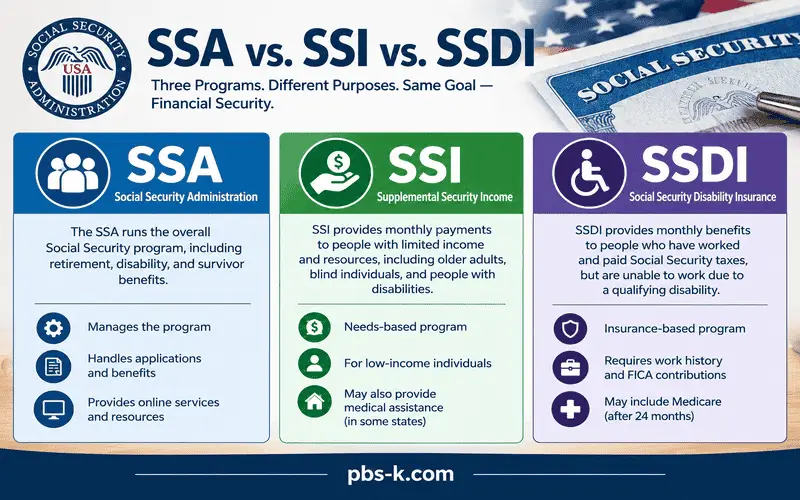
One of the most common sources of confusion is the difference between these three terms.
SSA
SSA is the agency.
It administers Social Security and SSI and performs other federal functions related to these programs.
SSDI
SSDI is a Social Security disability insurance program.
Eligibility is generally based on disability plus sufficient work credits and insured status. SSA explains that Title II disability benefits are available to insured individuals who meet the applicable disability requirements.
SSI
SSI means Supplemental Security Income.
It is a needs-based federal program for people who meet the applicable requirements, including certain older adults and people who are blind or disabled and have limited income and resources. SSI is funded through general federal revenues rather than Social Security trust funds.
A person can sometimes qualify for both SSDI and SSI, depending on their circumstances.
How Do Social Security Credits Work?
Social Security credits are one factor used to determine eligibility for certain benefits.
Workers earn credits through covered work and earnings. The number of credits needed depends on the type of benefit and, for some benefits, the person’s age.
For 2026, SSA states that workers receive one credit for every $1,890 in covered earnings, up to four credits during the year.
The dollar amount used to earn a credit can change from year to year, so older figures should not automatically be used when checking current eligibility.
Having enough credits does not by itself guarantee that someone qualifies for every Social Security program. Other requirements may apply.
How Much Could You Receive From SSA?
There is no single Social Security payment amount that applies to everyone.
Your benefit can depend on factors such as:
- Your covered earnings history
- The number of years you worked
- When you claim retirement benefits
- The type of benefit
- Your family situation
- Applicable program rules
SSA provides personalized estimates through my Social Security. The agency says its estimates are based on your earnings information and can show different potential retirement amounts based on when you apply.
For example, someone planning retirement should not rely on an internet article’s generic payment estimate when a personalized SSA estimate is available.
What Is a my Social Security Account?
my Social Security is SSA’s online account system.
It allows users to access personalized Social Security information and perform certain services without always needing to visit an office or call the agency.
Depending on your circumstances, you may be able to use the account to:
- View your Social Security Statement
- Review your earnings history
- Get personalized retirement estimates
- Check an application status
- Request certain replacement documents
- Change your address
- Change direct-deposit information
- Print benefit verification information
- Access tax forms
- View certain benefit information
SSA has also introduced improvements to the online account experience and retirement calculator during 2026.
Why Check Your Earnings Record?
Your earnings history is important because Social Security benefits can depend on your covered earnings.
Reviewing the record can help you identify missing or incorrect earnings before they affect a future benefit calculation.
Your personal my Social Security account lets you review your earnings and benefit information.
If something appears incorrect, follow SSA’s official process for correcting the record rather than relying on an unofficial service.
How Do You Apply for SSA Benefits?
The application process depends on the benefit you are seeking.
SSA provides online application options for several benefits, including retirement and disability-related services.
A practical starting process is:
- Identify the benefit you need.
Determine whether you are looking for retirement, disability, survivor, Medicare, or SSI assistance. - Review your eligibility.
Use information from SSA rather than assuming that age, income, or work history automatically qualifies you. - Create or access your my Social Security account when appropriate.
This can provide personalized information and estimates. - Gather relevant documents.
Depending on the application, SSA may require identification, earnings, medical, family, or other information. - Submit the application through an official SSA channel.
- Monitor the application.
Your online account may provide status information for eligible applications.
For disability claims, the process can require medical evidence and additional evaluation. SSA’s disability programs have specific medical and nonmedical requirements.
What Is Full Retirement Age?
Full retirement age, often abbreviated as FRA, is the age at which a person can receive their full retirement benefit under the applicable Social Security rules.
It is generally between 66 and 67, depending on birth year. For people attaining age 62 in 2026, the full retirement age is 67.
The earliest retirement claiming age remains 62.
This creates an important planning issue: the age when you become eligible to claim benefits is not necessarily the age when your monthly benefit is unreduced.
SSA provides an official retirement-age calculator that lets you determine your full retirement age based on your birth year.
Is SSA the Same as Medicare?
No. SSA and Medicare are different programs, although they interact in several ways.
SSA handles certain Medicare-related services and applications. For example, people can use Social Security services to apply for Medicare in applicable circumstances. SSA also provides information related to Medicare enrollment.
However, Medicare is the federal health insurance program for eligible people, while SSA is the federal agency administering Social Security programs.
This distinction is useful when searching for information because a Medicare question may involve SSA without being a Social Security retirement-benefit question.
How Can You Check Your SSA Information Online?
The safest approach is to start at the official SSA website rather than clicking an advertisement or an unexpected message.
A personal my Social Security account can provide access to personalized information such as your earnings record, Social Security Statement, benefit estimates, and application information.
Before entering sensitive information, check that you are using the official government website.
Avoid searching for a phone number and immediately calling the first result if you are unsure whether it is an official source. Government impersonation scams can use advertisements and convincing websites to redirect people to fraudulent services.
How to Avoid SSA Scams
Social Security impersonation scams are an important reason to be careful when searching for SSA information.
Scammers may pretend to be Social Security employees and claim there is a problem with your Social Security number, account, benefits, or bank information.
SSA and its Office of the Inspector General warn about fake calls, texts, emails, social media messages, websites, and letters.
Common Warning Signs
Be particularly cautious if someone claiming to be from SSA:
- Threatens immediate arrest
- Says your Social Security number will be suspended
- Demands immediate payment
- Requests gift cards
- Requests cryptocurrency
- Demands cash or a wire transfer
- Tells you to move money to “protect” it
- Requests sensitive information unexpectedly
- Pressures you to act immediately
- Asks you to keep the situation secret
SSA says legitimate government employees will not use these tactics to demand payment.
Be Careful With Search Results
An official-looking website is not necessarily an official website.
SSA’s Office of the Inspector General has warned that scammers may use online advertising and official-looking content to imitate government agencies.
For sensitive Social Security tasks, go directly to ssa.gov and navigate from there.
What If You Already Gave Information to a Scammer?
Act promptly.
If you provided personal information or believe someone misused your Social Security information, review your account directly through official SSA channels and consider the appropriate identity-theft reporting steps.
SSA recommends using your personal my Social Security account to monitor information and taking additional steps if identity theft occurred.
Social Security-related fraud can also be reported to the SSA Office of the Inspector General.
Practical SSA Checklist
If you are new to Social Security, the following checklist can make the process easier.
For retirement planning:
- Create a my Social Security account.
- Review your earnings record.
- Check your estimated retirement benefits.
- Find your full retirement age.
- Compare estimates for different claiming ages.
- Keep important personal information secure.
For disability questions:
- Determine whether SSDI, SSI, or both may be relevant.
- Review SSA’s eligibility requirements.
- Gather relevant medical and work information.
- Apply through an official SSA channel.
- Keep copies of submitted information.
- Monitor your application status.
For scam protection:
- Use SSA.gov directly.
- Do not click unexpected links.
- Do not give sensitive information to unsolicited callers.
- Never send payment because someone threatens to suspend your SSN.
- Do not move money because an unsolicited caller says it is necessary.
- Report suspicious activity through official channels.
Common Mistakes to Avoid With SSA
Confusing SSA With SSI
SSA is the agency. SSI is one of the programs administered by the agency.
Assuming Everyone Gets the Same Benefit
Social Security benefits vary according to individual circumstances, including earnings history and claiming age.
Using an Old Retirement-Age Figure
Retirement rules are not identical for every birth year. Check your full retirement age using SSA’s current information.
Ignoring Your Earnings Record
An incorrect earnings record can create problems when benefits are calculated. Reviewing your information before retirement can help you identify potential issues.
Trusting an Unsolicited Caller
Even if a caller knows your name, address, or other details, that does not prove the caller works for SSA. Scammers can obtain or fabricate personal information.
Paying for Routine SSA Forms
Be cautious when a third party asks for money for a service that is normally available directly through SSA.
Why the Official SSA Website Matters
Social Security involves sensitive information, including earnings records, Social Security numbers, benefit information, and sometimes bank details.
For that reason, the best source for personalized information is the Social Security Administration itself.
The official SSA website provides current information about programs, eligibility, applications, publications, online services, and scam warnings.
Third-party articles can help explain complicated topics, but they should not replace your official benefit estimate, account information, or an SSA determination.
Conclusion
SSA usually refers to the Social Security Administration, the U.S. federal agency responsible for administering Social Security and Supplemental Security Income programs.
For most people, the most useful first steps are to understand which program applies to their situation, review their earnings record, use a personal my Social Security account, and obtain personalized benefit information directly from SSA.
Because Social Security rules and online services can change, use the official SSA website for current eligibility requirements, applications, benefit estimates, and account services. Be especially careful with unexpected calls, emails, texts, and websites requesting money or sensitive information.
FAQs
What Does SSA Stand For?
SSA stands for Social Security Administration, the U.S. federal agency that administers Social Security programs and Supplemental Security Income.
Is SSA the Same as Social Security?
Not exactly. SSA is the agency, while “Social Security” commonly refers to the federal retirement, survivors, and disability insurance programs administered by that agency.
What Is the Difference Between SSA and SSI?
SSA is the Social Security Administration. SSI means Supplemental Security Income, a needs-based program administered by SSA for eligible people who meet its requirements.
What Is the Difference Between SSA and SSDI?
SSA is the agency. SSDI, or Social Security Disability Insurance, is one of the disability programs administered by SSA. SSDI generally depends on disability and an individual’s insured status based on covered work.
How Do I Check My SSA Benefits?
You can use a personal my Social Security account to access personalized benefit estimates, your Social Security Statement, earnings information, and other available services.
What Is My Full Retirement Age?
Your full retirement age depends on your birth year. For people attaining age 62 in 2026, it is 67. SSA provides an official calculator to determine the applicable age for your situation.
Can I Get Social Security at Age 62?
Generally, age 62 is the earliest age for Social Security retirement benefits. However, starting benefits before full retirement age can reduce the monthly amount.
How Do I Protect Myself From SSA Scams?
Use the official SSA website, avoid unexpected links, and never send money or sensitive information because an unsolicited caller threatens you or claims your Social Security number has a problem. SSA specifically warns about impersonation scams involving calls, texts, emails, websites, and social media.
Can I Apply for Social Security Online?
Yes. SSA provides online application services for several benefits, including retirement and disability-related benefits. The exact online options depend on the benefit and your circumstances.
Does SSA Provide a Benefit Estimate?
Yes. A personal my Social Security account can provide personalized estimates based on your earnings record and different potential claiming ages.
Eternal Sources
Official Social Security Administration — Main source for Social Security programs, applications, eligibility and services.
my Social Security Account — Official account access and personalized Social Security information.