
Introduction
Finding your first job can feel frustrating when employers ask for experience before they are willing to hire you. You may have completed your education, learned useful skills, and prepared your resume, yet many entry-level job postings still request one or two years of previous work experience.
So, why do entry level jobs require experience when they are supposed to be suitable for beginners?
Employers usually want candidates who can apply their knowledge, communicate effectively, solve basic problems, and handle workplace responsibilities with less supervision. Some employers also use experience requirements to reduce hiring risks or narrow down a large number of applications.
However, not every employer expects candidates to have years of professional experience. Internships, school projects, volunteer work, part-time jobs, freelance assignments, and personal projects can demonstrate relevant abilities.
Understanding what employers actually want can help you find suitable opportunities, improve your resume, and apply with greater confidence.
What Is an Entry-Level Job?
An entry-level job is a position designed for someone who is beginning a career or has limited experience in a particular field. These roles often provide an opportunity to develop professional skills, learn company procedures, and gain practical knowledge.
Common examples include:
- Junior administrative assistant
- Customer service representative
- Entry-level sales associate
- Junior marketing assistant
- Data entry clerk
- IT support trainee
- Graduate trainee
- Junior content writer
The exact requirements depend on the employer, industry, and responsibilities of the position.
For example, an entry-level retail job may focus on communication, reliability, and customer service. A junior software development role may require knowledge of programming languages and evidence of practical coding ability.
The important distinction is that entry-level does not always mean zero experience. Some employers use the term for positions that require basic professional skills, while others use it for structured training opportunities intended for beginners.
Why Do Entry-Level Jobs Require Experience?
There are several reasons employers request experience for entry-level positions. Understanding these reasons can help you decide which qualifications matter most and how to demonstrate your abilities without a long work history.
1. Employers Want Candidates Who Can Perform Basic Tasks
Hiring managers often want new employees to understand the basics of a job before joining the company.
Even relatively simple positions may involve deadlines, customer communication, computer systems, teamwork, and following workplace procedures.
For example, a junior administrative assistant might need to organize documents, respond to emails, update spreadsheets, and schedule meetings. An applicant who has completed a relevant college project or managed administrative tasks in a volunteer role may already understand some of these responsibilities.
Employers may therefore request experience because they want evidence that candidates can apply their knowledge in practical situations.
2. Experience Can Reduce Training Time
Training new employees requires time and resources. Managers may need to explain company procedures, demonstrate software, review work, and correct mistakes.
Candidates with relevant experience may already understand some of these tasks, which can reduce the amount of initial instruction they need.
However, this does not mean experienced applicants require no training. Every workplace has its own systems, expectations, and processes.
A candidate who has used Excel for a college project, for example, may learn spreadsheet-related duties faster than someone who has never used it. That practical familiarity can be useful even without previous full-time employment.
3. Employers Receive Too Many Applications
Popular entry-level positions can attract many applicants. Employers may use qualifications, skills, and experience requirements to narrow the applicant pool.
If a company receives hundreds of applications for one opening, a recruiter may prioritize candidates who have already demonstrated relevant abilities.
Experience can become a screening factor, even when the actual responsibilities could be learned by a motivated beginner.
This also explains why a job advertisement may contain a long list of preferred qualifications. Some requirements are essential, while others describe the employer’s ideal candidate.
You should read the entire description instead of assuming that every listed preference is an absolute requirement.
4. Employers Want Evidence of Workplace Skills
Education can demonstrate knowledge, but employers may also want evidence that you can use that knowledge effectively.
They may look for skills such as:
- Clear written and verbal communication
- Time management and organization
- Problem-solving
- Teamwork and collaboration
- Reliability and attention to detail
- Basic digital skills
- Adaptability and willingness to learn
These abilities can develop through many activities, not just paid employment.
For example, organizing a university event can demonstrate planning and coordination. Completing a group assignment can show collaboration. Managing a small online project can demonstrate initiative and basic business skills.
The goal is to explain what you actually did and how it relates to the job.
5. Some Entry-Level Jobs Are More Demanding Than They Sound
Job titles do not always reflect the level of responsibility involved.
A junior accountant might need to work with financial records, follow strict procedures, and identify errors. An entry-level IT technician may need to troubleshoot computer problems and explain technical solutions to users.
These responsibilities can require specific knowledge or practical ability from the beginning.
In some industries, employers may also need applicants to meet formal licensing, certification, safety, or regulatory requirements. Relevant experience may be important for these positions even if the job title includes the words “entry-level.”
Before applying, check whether the requirement concerns a learnable workplace skill or a qualification that is genuinely necessary to perform the job.
6. Employers Want to Limit Hiring Risks
Hiring the wrong person can cost an employer time and money. A company may have to repeat recruitment, provide additional training, or redistribute work among existing employees.
Previous experience can offer some evidence that a candidate has handled similar responsibilities successfully.
However, experience is not a guarantee of good performance. Someone with limited work history may be dependable, quick to learn, and highly capable.
This is why practical assessments, interviews, work samples, and references can also help employers evaluate candidates.
For applicants, the opportunity is to provide other credible evidence of their abilities rather than relying entirely on a list of previous job titles.
7. Some Job Postings Use Experience as a Preference
Not every experience requirement is equally strict.
A job advertisement might say:
- Required: Candidates must have a specified qualification or minimum experience.
- Preferred: The employer would like candidates to have the experience but may consider alternatives.
- Equivalent experience accepted: Relevant skills gained through other activities may qualify.
- Entry-level or trainee: The position may be designed to teach the successful candidate.
The wording matters. A role requiring a legally mandated license is different from a marketing position that merely prefers previous campaign experience.
The University of Pennsylvania Career Services advises applicants to consider transferable skills and notes that, outside certain formal hiring systems, job descriptions can include qualifications beyond the minimum needed to apply. University of Pennsylvania+1
If you meet most of the essential requirements, applying may be worthwhile even when you do not meet every preferred qualification.
Is the Entry-Level Experience Requirement Fair?
The requirement can create a genuine challenge for people starting their careers.
A beginner needs a first opportunity to gain experience, but some employers prefer candidates who already have it. This creates what the International Labour Organization calls the “youth experience trap,” in which young people face barriers because jobs require prior experience they have not yet had the opportunity to develop. International Labour Organization
There are reasonable reasons for employers to seek evidence of practical ability. The problem arises when they demand extensive experience for a role that offers little responsibility, limited training, and few opportunities for independent decision-making.
A more balanced approach is to evaluate candidates on relevant skills, potential, education, and demonstrated ability, while providing appropriate training for the position.
As a job seeker, you cannot control every employer’s requirements. You can, however, focus on employers that welcome beginners, offer structured training, or accept practical projects and transferable skills in place of direct experience.
What Counts as Experience for an Entry-Level Job?
Experience does not always mean holding a full-time job in the same industry. Many activities can help you demonstrate that you have the skills needed for a position.
How To Choose a Laptop for College — Ceedo
Academic Projects
Coursework, research assignments, presentations, and group projects can demonstrate research, writing, analysis, teamwork, or technical skills.
Confident middle-aged businesswoman help intern working on laptop
Internships and Work Placements
Internships provide opportunities to learn workplace practices, complete practical tasks, and develop contacts in your chosen field.
Mature adult female coordinator directs mid adult female volunteer
Volunteer Work
Helping a charity, community group, or school organization can demonstrate responsibility, communication, and coordination.
How to Create a Portfolio that Attracts Recruiters | by Yogesh Dahake | Write A Catalyst | Medium
Freelance and Personal Projects
A website, writing portfolio, design collection, coding project, or small business can show what you can do in practice.
Perfect POS | Cloud Retail Point of Sale System
Part-Time and Unrelated Jobs
A retail, hospitality, or delivery job may help you demonstrate punctuality, customer service, teamwork, and problem-solving skills that transfer to other roles.
These experiences are most useful when you explain the responsibilities you handled and the skills you developed. Do not present a personal project as paid employment or claim professional experience you did not have.
How to Get an Entry-Level Job With No Experience
You do not need to wait until you have a perfect resume to start applying. Instead, build evidence of your abilities and target jobs that match your current qualifications.
1. Search for Beginner-Friendly Job Titles
Start with roles that are more likely to accept applicants with limited experience.
Search for terms such as:
- Entry-level jobs with no experience
- Junior positions
- Graduate trainee programs
- Assistant positions
- Internships
- Apprenticeships
- Paid training programs
- Entry-level customer support
- Junior administrative roles
Read each advertisement carefully because the same job title can have different requirements at different companies.
Look for language such as “training provided,” “graduates welcome,” “no previous experience required,” and “willingness to learn.”
These phrases can help you identify opportunities that are more suitable for beginners.
2. Build Practical Skills Before Applying
Choose a few skills that appear repeatedly in job advertisements for your target role.
For example, someone seeking an entry-level administrative job might learn spreadsheet basics, professional email writing, document formatting, and calendar management.
A person interested in digital marketing could create a sample content calendar, prepare a mock campaign, or build a small website.
A beginner applying for IT support positions could practice troubleshooting common computer problems and document the steps taken to solve them.
You do not need to master everything before applying. Focus on developing enough knowledge to demonstrate your readiness for the role.
3. Create a Resume That Highlights Your Strengths
If you have no formal employment history, place greater emphasis on your education, skills, projects, and relevant activities.
A beginner-friendly resume can include:
- Contact information.
- A short professional summary, if useful.
- Education and relevant coursework.
- Projects or volunteer experience.
- Technical and job-related skills.
- Certifications relevant to the position.
Use clear descriptions that explain your contribution.
For example, instead of writing:
“Completed a college project.”
You could write:
“Created a spreadsheet to organize survey responses, calculate totals, and present findings in a summary report.”
The second description gives an employer a clearer picture of the work you can perform.
Keep every statement truthful and specific. If you have measurable results, include them only when you can support them.
4. Match Your Application to the Job Description
Sending the same resume to every employer can make it harder to show why you are suitable for a particular position.
Before applying, identify the most important requirements in the advertisement. Then connect each requirement to a relevant example from your education, projects, volunteering, or previous work.
For example:
| Employer requirement | Evidence you could provide |
|---|---|
| Communication | Class presentations or customer service work |
| Organization | Event planning or project coordination |
| Spreadsheet skills | A completed Excel project |
| Problem-solving | A technical project or troubleshooting task |
| Teamwork | Group assignments or volunteer activities |
This approach makes your application more specific without exaggerating your qualifications.
5. Use a Cover Letter to Explain Your Potential
A cover letter can help you explain why you are interested in a role and how your existing skills relate to the employer’s needs.
You do not need to apologize for being new to the industry. Instead, explain what you have learned, what you can contribute, and how you are prepared to develop further.
For example:
“I recently completed coursework in business administration and developed practical spreadsheet and organizational skills through academic projects. I am interested in this position because it would allow me to apply those skills while learning your company’s administrative processes.”
Adjust the wording to reflect your actual background and the position.
6. Prepare Examples for Interviews
Employers may ask questions about teamwork, handling challenges, meeting deadlines, or learning something unfamiliar.
You can prepare answers using the STAR method:
- Situation: Explain the context.
- Task: Describe what needed to be done.
- Action: Explain the steps you took.
- Result: Share the outcome or what you learned.
Your example can come from a school assignment, volunteer activity, part-time job, or personal project.
For instance, if an interviewer asks how you handle deadlines, describe a project with a clear deadline, how you organized the work, and how you completed your responsibilities.
This gives the interviewer evidence of your approach, even if you have not held a formal professional position.
7. Build Connections in Your Chosen Field
Networking can help you learn about opportunities that are not obvious from job advertisements.
Consider contacting alumni, attending career events, joining professional communities, or asking people in your chosen field about their career paths.
You can also ask experienced professionals which beginner skills employers value and whether their organizations offer internships or training programs.
Networking does not guarantee employment, but it can help you understand industry expectations and discover additional routes into a career.
How to Identify Jobs That Truly Welcome Beginners
Not every position advertised as entry-level will be a good match for someone without experience. Use the following checklist to assess opportunities before spending time on an application.
Job Advertisement Checklist
Check each item as you review a job posting.The advertisement says training is provided or beginners may apply.The experience requirement is preferred rather than mandatory.My current skills match the main responsibilities.I meet any essential education, licensing, or certification requirements.The salary, duties, and working conditions are clearly explained.
0 of 5 checkedReset
Use this checklist to compare opportunities, not as a guarantee of eligibility or hiring success.
Be cautious when an advertisement promises a job without a proper interview, requests payment to secure employment, or asks for sensitive financial information before there is a legitimate need. Verify the employer and recruitment process before sharing personal information.
Should You Apply If You Do Not Meet the Experience Requirement?
In many cases, yes. The right decision depends on whether the experience requirement is essential and how closely your skills match the job.
Consider applying when:
- The advertisement describes experience as preferred.
- You have relevant projects or transferable skills.
- You meet the essential education or certification requirements.
- You can demonstrate that you understand the main responsibilities.
- The employer appears open to training or developing new employees.
You may need to prioritize other opportunities when the role clearly requires a specific license, legally mandated experience, or technical ability you do not yet possess.
For government positions and other formal recruitment systems, eligibility rules may be strict. For example, the United States Office of Personnel Management explains that applicants must check the eligibility and qualification requirements in individual federal job announcements. Recent Graduates
A useful strategy is to divide your job search between positions where you meet nearly all requirements and opportunities where you meet most requirements but would need to learn a few additional skills.
This allows you to pursue realistic options while gradually building the experience needed for more demanding roles.
What Employers Can Do to Make Entry-Level Hiring Better
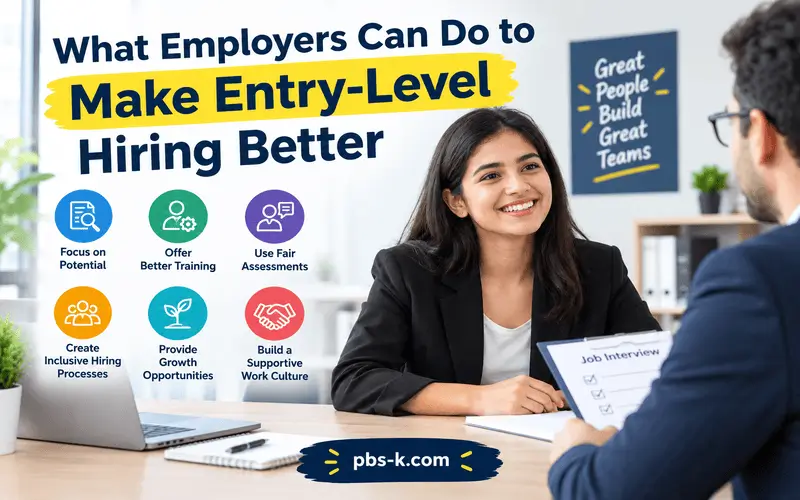
The experience gap is not only a challenge for job seekers. Employers can also improve how they recruit beginners.
Useful approaches include:
- Listing essential qualifications separately from preferred qualifications.
- Assessing practical skills through relevant work samples.
- Offering internships, apprenticeships, and graduate training programs.
- Considering projects, volunteer work, and transferable skills.
- Providing structured onboarding and mentoring.
- Setting experience requirements that reflect the actual responsibilities of the role.
These approaches can help employers identify capable candidates who may have been overlooked because they lack traditional employment history.
For job seekers, this means it is worth looking beyond large, well-known employers. Smaller companies, nonprofit organizations, local businesses, and structured early-career programs may offer useful ways to develop professional skills.
Conclusion
Entry-level jobs often require experience because employers want candidates who can demonstrate practical skills, communicate effectively, and handle workplace responsibilities. Competition for openings, training costs, and industry-specific requirements can also influence hiring decisions.
However, a lack of formal employment history does not mean you have nothing to offer. Academic projects, internships, volunteer work, part-time jobs, and personal projects can all provide evidence of relevant abilities.
Start by identifying beginner-friendly positions, tailoring your resume to the role, and building practical skills that employers value. Most importantly, distinguish between essential requirements and preferred qualifications so you can focus your time on opportunities that match your potential.
FAQs
Why do entry level jobs require experience?
Employers often want candidates who can apply their knowledge, complete basic tasks, communicate effectively, and work with less supervision. Experience can also help recruiters compare applicants when a position attracts many candidates. However, some employers accept projects, internships, and transferable skills instead of direct employment history.
How can I get an entry-level job with no experience?
Start by searching for trainee positions, internships, apprenticeships, and jobs that offer training. Build relevant skills through projects or volunteering, prepare a resume that highlights your abilities, and apply for positions where you meet the essential requirements.
Do internships count as work experience?
Yes. Internships can count as relevant experience because they expose you to workplace tasks, professional communication, and industry practices. The value depends on the responsibilities you handled and how closely they relate to the job you want.
Should I apply for a job that requires one year of experience?
You can consider applying if the requirement is flexible and you can demonstrate relevant skills through projects, volunteering, education, or other work. If the advertisement identifies the experience as a strict eligibility requirement, check with the employer before assuming an alternative will qualify.
What if every entry-level job requires experience?
Expand your search to include internships, graduate programs, apprenticeships, temporary positions, part-time work, and junior assistant roles. You can also build a small portfolio or complete relevant projects to demonstrate your skills. Focus on gaining practical evidence of your abilities rather than waiting for the perfect job advertisement.
Can I get a job without experience or a degree?
Yes, some jobs accept applicants without previous experience or a college degree. Requirements vary by occupation and employer. Retail, hospitality, customer support, delivery, and some trainee roles may offer accessible entry routes, while regulated professions can require formal qualifications.
What experience should I put on my resume if I have never worked?
Include relevant academic projects, volunteer activities, internships, freelance assignments, personal projects, and leadership responsibilities. Explain what you did, which skills you used, and what you accomplished. Keep the descriptions accurate and do not present unpaid or personal activities as paid employment.
Why do employers ask for three years of experience for junior positions?
Some employers use broad or overly demanding job descriptions, while others need candidates who can handle more complex tasks with limited supervision. The title alone does not tell you whether the requirement is flexible. Review the actual duties and distinguish essential qualifications from preferences before applying.