
Introduction
Have you ever heard someone say, “Time is money” or “The classroom was a zoo”? These expressions might sound unusual if you take them literally. However, they communicate ideas by comparing one thing to another. This type of expression is called a metaphor.
If you are wondering what does metaphor mean, the simple answer is that a metaphor is a figure of speech that describes one thing as another to show a similarity between them. It does not mean that the two things are actually the same. Instead, it helps people understand an idea, feeling, or situation in a more interesting way.
Metaphors are common in everyday conversations, books, poems, songs, speeches, and even educational writing. They make language more expressive and help readers imagine what someone is trying to communicate.
In this guide, you will learn the meaning of metaphor, see easy examples, understand how metaphors differ from similes, and discover how to use them in your own sentences.
What Does Metaphor Mean?
A metaphor is a figure of speech that directly compares two different things by describing one as the other. The comparison suggests that the two things share a particular quality, characteristic, or idea.
For example:
“My brother is a walking encyclopedia.”
This does not mean that your brother is literally a book. It means he knows a lot of information and can answer many questions, just like an encyclopedia.
Here is another example:
“Life is a journey.”
Life is not an actual road or trip. This metaphor compares life to a journey because both involve experiences, changes, challenges, and different destinations.
The purpose of a metaphor is to communicate an idea in a creative and memorable way. Instead of using a long explanation, a speaker or writer can use a short comparison to help the audience understand a particular meaning.
Metaphors are part of figurative language, which uses words in ways that go beyond their literal meanings.
Simple Definition of Metaphor in Easy Words
In simple words, a metaphor means saying that one thing is another thing to explain an idea or show a similarity.
For example:
- The world is a stage: Life is compared to a performance in which people play different roles.
- Her voice is music: Her voice sounds beautiful or pleasant.
- He has a heart of stone: He seems unkind or emotionally distant.
- Books are windows: Books help people explore different ideas, experiences, and perspectives.
These sentences are not meant to be understood literally. They use comparisons to create a clearer picture in the reader’s mind.
A helpful way to remember the definition is:
A metaphor describes something by comparing it directly to something else without saying that it is literally the same thing.
15 Easy Examples of Metaphors and Their Meanings
The easiest way to understand metaphors is to look at examples from everyday life. The following expressions show how a metaphor can make a simple sentence more interesting.
| Metaphor example | What it actually means |
|---|---|
| Time is money. | Time is valuable and should be used wisely. |
| The classroom was a zoo. | The classroom was noisy and disorderly. |
| He has a heart of stone. | He seems cold or unkind. |
| Her smile is sunshine. | Her smile makes people feel happy. |
| Life is a journey. | Life involves experiences and changes. |
| The world is a stage. | People play different roles in life. |
| Books are windows. | Books open opportunities to learn. |
| My mind is a battlefield. | I am struggling with difficult thoughts. |
| The news was a bombshell. | The news was extremely surprising. |
| He is a shining star. | He is talented or successful. |
| My home is my castle. | My home is a place of safety and comfort. |
| Anger is a fire. | Anger can grow and become difficult to control. |
| Her words were daggers. | Her words were deeply hurtful. |
| The city is a jungle. | The city feels competitive or difficult to navigate. |
| His ideas are seeds. | His ideas can develop into something valuable. |
Notice that each example compares two different things. The comparison helps communicate an emotion, characteristic, or experience without explaining every detail.
Metaphor Examples in Everyday Sentences
Here are a few examples showing how metaphors work in complete sentences.
1. “The exam was a nightmare.”
Meaning: The exam was extremely difficult or stressful.
2. “My father is my rock.”
Meaning: My father provides support, strength, and stability.
3. “Her bedroom is a disaster zone.”
Meaning: Her bedroom is very messy.
4. “The internet is an information highway.”
Meaning: The internet provides access to large amounts of information and connects people.
5. “His words opened a door to new opportunities.”
Meaning: Something he said helped create new possibilities.
These expressions make everyday communication more descriptive and engaging.
What Are the Different Types of Metaphors?
Metaphors can appear in several forms. Some are short and familiar, while others develop a comparison across an entire sentence, paragraph, poem, or story.
Understanding these types can help you recognize metaphors in reading and use them more effectively in writing.
1. Standard Metaphor
A standard metaphor directly describes one thing as another.
For example:
“The snow was a white blanket.”
The snow is compared to a blanket because it covers the ground and creates a soft, continuous layer.
Another example is:
“She is a ray of sunshine.”
This means she brings happiness and positivity to the people around her.
2. Implied Metaphor
An implied metaphor makes a comparison without directly stating that one thing is another.
For example:
“The angry teacher barked instructions at the students.”
The teacher is not literally barking like a dog. Instead, the verb “barked” suggests that the teacher spoke in a harsh or forceful way.
Another example:
“He bulldozed his way through the discussion.”
This suggests that he dominated the discussion without considering other people’s opinions.
Implied metaphors often use verbs or descriptive words to communicate a comparison indirectly.
3. Extended Metaphor
An extended metaphor develops one comparison over several sentences, lines, or even an entire piece of writing.
For example:
“Life is a journey. Some days, the road is smooth, while other days are full of unexpected turns. We meet different people along the way, overcome obstacles, and discover new destinations.”
This example continues comparing life to a journey throughout the passage.
Extended metaphors are especially useful in poetry, storytelling, speeches, and creative writing because they allow writers to explore an idea in greater detail.
4. Mixed Metaphor
A mixed metaphor combines two or more unrelated metaphorical comparisons in a way that may sound confusing or awkward.
For example:
“We need to get this project off the ground before the clock runs out of fuel.”
This sentence mixes the idea of a project taking flight with a clock running out of fuel.
Mixed metaphors are not always intentional. Writers sometimes use them accidentally when combining familiar expressions.
They can be used creatively for humor, but they should generally be avoided in formal writing when they make the meaning unclear.
5. Dead Metaphor
A dead metaphor is an expression that originally used figurative language but has become so common that people often do not notice the comparison anymore.
For example:
- The foot of the mountain.
- The leg of a table.
- The hands of a clock.
- The head of a department.
People understand these expressions as ordinary language without usually thinking about their original comparisons.
Dead metaphors demonstrate how figurative expressions can become part of everyday vocabulary.
What Is the Difference Between a Metaphor and a Simile?
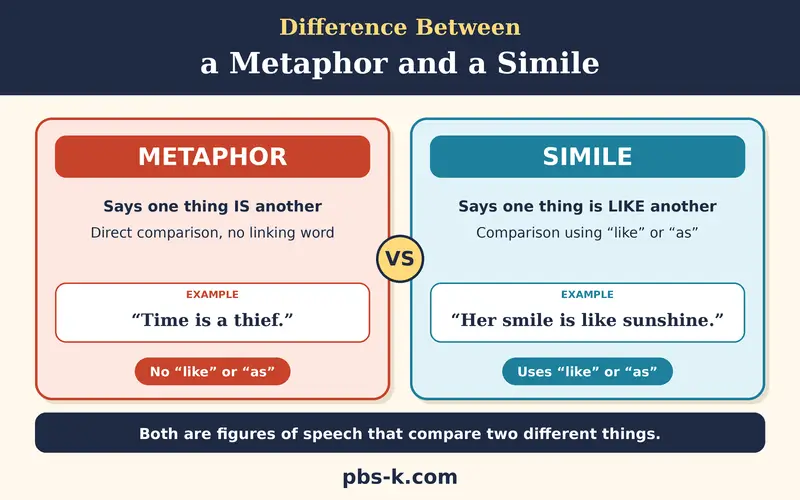
Metaphors and similes are both figures of speech. They compare two different things to highlight a shared characteristic.
However, they use different structures.
A metaphor directly describes one thing as another, while a simile compares two things using words such as “like” or “as.”
Consider these examples:
- Metaphor: “Her eyes are stars.”
- Simile: “Her eyes shine like stars.”
Both sentences suggest that her eyes are beautiful or bright. However, the metaphor makes a direct comparison, while the simile clearly signals the comparison with the word “like.”
Metaphor vs. Simile Comparison Table
| Feature | Metaphor | Simile |
|---|---|---|
| Meaning | Direct comparison | Expressed comparison |
| Common structure | One thing is another | One thing is like another |
| Uses like or as? | Not in the usual direct comparison | Usually uses like or as |
| Example | He is a lion. | He is like a lion. |
| Purpose | Creates a direct image or association | Highlights a similarity |
| Writing style | Often more direct and imaginative | Often more descriptive |
More Examples of Metaphors and Similes
Here are additional examples to make the difference easier to understand.
Example 1: A hardworking person
- Metaphor: “She is a machine.”
- Simile: “She works like a machine.”
Both expressions suggest that she works very hard or efficiently.
Example 2: A cold person
- Metaphor: “He is an iceberg.”
- Simile: “He is as cold as an iceberg.”
Both suggest that the person seems emotionally distant.
Example 3: A fast runner
- Metaphor: “He is a cheetah on the track.”
- Simile: “He runs like a cheetah.”
Both expressions describe someone who runs very quickly.
Quick tip: If a sentence directly describes one thing as another to suggest a shared quality, it may be a metaphor. If it uses “like” or “as” to make the comparison, it is generally a simile.
Why Do Writers Use Metaphors?
Writers use metaphors because they make communication more expressive. A simple sentence can become more interesting when it creates a picture or connects two different ideas.
Here are some important reasons metaphors are useful.
1. They Make Ideas Easier to Understand
Some ideas are difficult to explain directly. A metaphor can connect an unfamiliar concept to something people already understand.
For example:
“The brain is a control center.”
This metaphor helps readers understand that the brain manages and coordinates many activities in the body.
It is a simplified comparison rather than a complete scientific description.
2. They Create Strong Mental Images
Metaphors help readers imagine what a writer is describing.
For example:
“The sky was a canvas of colors.”
This expression encourages readers to picture a sky filled with different shades, much like a painting.
It creates a more vivid image than simply saying that the sky was colorful.
3. They Express Emotions
Metaphors can communicate feelings that are difficult to describe directly.
For example:
“My heart is broken.”
This does not mean that the heart is physically damaged. It communicates deep emotional pain, sadness, or disappointment.
Similarly, “I am carrying a heavy burden” can describe emotional stress or responsibility.
4. They Make Writing More Memorable
A creative comparison can make a sentence easier to remember.
For example:
“Knowledge is a treasure.”
This short metaphor communicates that knowledge is valuable and worth collecting.
Such expressions can be effective in speeches, educational materials, stories, and advertisements.
5. They Make Creative Writing More Interesting
Metaphors give writers more ways to describe characters, places, feelings, and events.
Instead of writing:
“The room was very quiet.”
A writer might say:
“Silence was a blanket covering the room.”
The second sentence creates a stronger atmosphere and gives the reader a more imaginative description.
How to Identify a Metaphor in a Sentence
Finding a metaphor becomes easier when you know what to look for.
Use these simple steps when reading a sentence, poem, story, or passage.
Step 1: Look for a Comparison
Check whether the sentence describes one thing as something different.
For example:
“The teacher is a fountain of knowledge.”
The teacher and a fountain are different things, so the sentence contains a comparison.
Step 2: Check Whether the Meaning Is Literal
Ask yourself whether the sentence can be true in its ordinary, physical sense.
A teacher cannot literally be a fountain. Therefore, the sentence is using figurative language.
Step 3: Find the Shared Quality
Think about what the two things have in common.
In the example above, a fountain provides water, while the teacher provides knowledge and information.
The shared idea is that both provide something useful to others.
Step 4: Explain the Intended Meaning
Rewrite the sentence in simple, direct language.
For example:
“The teacher is a fountain of knowledge.”
Literal explanation: The teacher knows a lot and shares information with students.
This final step is especially helpful when answering English homework questions or analyzing poetry.
How to Write Your Own Metaphor
You do not need to be a professional writer or poet to create a metaphor. You can make one by connecting an ordinary idea with something that shares a similar quality.
Follow these steps.
Step 1: Choose something to describe.
Start with a person, feeling, place, object, or experience.
Example: A difficult day.
Step 2: Think about its main qualities.
Ask yourself what makes the subject special.
A difficult day might feel tiring, stressful, long, or exhausting.
Step 3: Find something with a similar quality.
Think of an object or situation that creates a similar impression.
For example, a difficult day might feel like a storm.
Step 4: Turn the comparison into a metaphor.
Instead of saying, “My day was like a storm,” write:
“My day was a storm.”
Step 5: Check whether the meaning is clear.
Make sure readers can understand the connection without needing too much explanation.
More Original Metaphor Ideas
You can use the following examples as inspiration:
- “Friendship is a bridge.” It connects people and helps them support each other.
- “Hope is a candle.” It provides light during difficult times.
- “My desk is a mountain of paperwork.” It has a very large pile of documents.
- “The playground was an ocean of excitement.” The children were full of energy and enthusiasm.
- “Patience is a quiet strength.” It helps people handle difficult situations calmly.
When creating your own metaphors, choose comparisons that communicate a clear idea. Unusual comparisons can be creative, but they should still make sense to the reader.
Common Mistakes People Make When Understanding Metaphors
Although metaphors are relatively simple, beginners sometimes confuse them with other types of figurative language.
Here are some mistakes to avoid.
1. Taking the Metaphor Literally
If someone says, “My teacher is a superhero,” they are probably describing the teacher as helpful, supportive, or inspiring.
They are not claiming that the teacher has supernatural powers.
Always consider the intended meaning instead of interpreting every word literally.
2. Confusing Metaphors With Similes
A metaphor and a simile both make comparisons, but they are not structured in the same way.
- Metaphor: “The baby is an angel.”
- Simile: “The baby is like an angel.”
The first directly describes the baby as an angel. The second uses “like” to express the comparison.
3. Assuming Every Comparison Is a Metaphor
Not every descriptive sentence contains a metaphor.
For example:
“The red car is faster than the blue car.”
This is a direct comparison of speed. It is not a metaphor because it does not use one thing to represent another in a figurative way.
4. Using Confusing Mixed Metaphors
Combining unrelated comparisons can make writing difficult to understand.
For example:
“We need to sail through this problem and hit the ground running.”
This expression mixes different images. It may work in casual speech, but it can sound awkward in formal writing.
Using one clear comparison is usually more effective.
Where Are Metaphors Commonly Used?
Metaphors are not limited to English classes or poetry. They appear in many areas of everyday communication.
In Everyday Conversations
People frequently use metaphors without thinking about them.
Examples include:
- “I am drowning in work.”
- “That person has a golden heart.”
- “This place is a madhouse.”
- “You are my sunshine.”
These expressions make conversations more colorful and help communicate emotions quickly.
In Poetry and Literature
Poets and authors use metaphors to express complex feelings and ideas.
For example, William Shakespeare’s famous line in Romeo and Juliet, “It is the east, and Juliet is the sun,” compares Juliet to the sun to express her importance and brightness.
The comparison creates an image that communicates admiration and emotional intensity.
In Songs and Speeches
Songwriters and public speakers use metaphors to create emotional connections with their audiences.
For example, describing hope as a light can suggest encouragement during difficult times.
Metaphors can also make a message more memorable because listeners connect an abstract idea with a familiar image.
In Education and Science
Teachers often use metaphors to explain complicated concepts in simpler language.
For example, describing the brain as a control center can help students understand its coordinating role.
However, educational metaphors are simplified explanations. They should not be mistaken for complete scientific descriptions.
Metaphor vs. Other Figures of Speech
Metaphor is one of several literary devices used in figurative language. Knowing how it differs from related terms can help you identify the correct figure of speech.
| Figure of speech | Definition | Example |
|---|---|---|
| Metaphor | Directly compares two different things. | The world is a stage. |
| Simile | Compares using like or as. | The world is like a stage. |
| Personification | Gives human qualities to non-human things. | The wind whispered. |
| Hyperbole | Uses deliberate exaggeration. | I have told you a million times. |
| Symbolism | Uses something to represent a broader idea. | A dove can represent peace. |
| Analogy | Explains an idea through a comparison of relationships or situations. | Learning is like building a house, one step at a time. |
These literary devices can sometimes overlap. For example, a metaphor may also communicate symbolism, but the terms do not mean exactly the same thing.
Understanding their differences makes it easier to analyze literature and improve your writing.
Is a Metaphor Always Figurative?
Yes, a metaphor uses language in a figurative rather than literal sense. However, some metaphors become so familiar that people use them as ordinary expressions without noticing their figurative meaning.
For example, “the foot of the mountain” refers to the lower part of a mountain. It does not mean that the mountain has a physical foot.
Other expressions, such as “the hands of a clock” and “the leg of a chair,” work in a similar way.
These familiar expressions are often described as dead metaphors because their original comparisons have become part of everyday language.
The important point is that a metaphor does not need to sound poetic or unusual. It can appear in ordinary speech and writing.
FAQs
What Does Metaphor Mean in Simple Words?
A metaphor is a figure of speech that describes one thing as another to show a similarity. For example, “My father is my rock” means that he provides strength, support, and stability.
What Is a Simple Example of a Metaphor?
“Time is money” is a simple metaphor. It means that time is valuable and should be used wisely. Time is not literally money, but both are considered valuable resources.
What Are the Five Examples of Metaphors?
Here are five common examples:
- Life is a journey.
- Her smile is sunshine.
- He has a heart of stone.
- The classroom was a zoo.
- Books are windows to the world.
Each example compares two different things to communicate a particular meaning.
What Is the Difference Between a Metaphor and a Simile?
A metaphor directly describes one thing as another, while a simile uses words such as “like” or “as” to compare two things.
For example, “He is a lion” is a metaphor, while “He is like a lion” is a simile.
Is “Life Is a Journey” a Metaphor?
Yes. “Life is a journey” is a metaphor because it compares life to a journey. It suggests that life includes different experiences, challenges, changes, and destinations.
Can a Metaphor Be One Word?
Yes. A metaphor does not always need to be a complete sentence. A single word can create a metaphorical meaning when it describes something figuratively.
For example, calling someone a “star” can suggest that the person is talented, successful, or admired.
What Are the Four Main Types of Metaphors?
Commonly taught types include standard metaphors, implied metaphors, extended metaphors, and mixed metaphors. Dead metaphors are another important category. Different educational resources may classify metaphors in slightly different ways.
Why Are Metaphors Important in English?
Metaphors make language more expressive and help readers understand complicated ideas. They also create mental images, communicate emotions, and make creative writing more engaging.
Is “The Classroom Is a Zoo” a Metaphor?
Yes. It is a metaphor because it compares a classroom to a zoo. It usually means that the classroom is noisy, crowded, or disorderly, rather than suggesting that real animals are present.
How Can I Identify a Metaphor in a Sentence?
Look for a comparison between two different things. Then ask whether the sentence is meant literally. If one thing is described as another to suggest a shared quality, it is likely a metaphor.
Conclusion
Understanding what does metaphor mean can make reading, writing, and everyday communication much easier. A metaphor is a figure of speech that compares two different things by describing one as the other. It helps people express emotions, explain ideas, and create memorable descriptions.
Expressions such as “Time is money,” “Life is a journey,” and “My father is my rock” show how metaphors communicate deeper meanings through simple comparisons.
The best way to understand metaphors is to practice identifying them in everyday conversations, books, poems, and sentences. Once you recognize the connection between the two things being compared, understanding their intended meaning becomes much easier.