
Introduction
Madonna is an American singer, songwriter, actress, and record producer widely known as the Queen of Pop. Born Madonna Louise Ciccone on August 16, 1958, she became one of the most influential figures in modern popular music through her hit songs, creative music videos, bold fashion choices, and ability to reinvent her sound.
Her career began to take off in the early 1980s, and she went on to release successful albums such as Like a Virgin, True Blue, Like a Prayer, Ray of Light, and Confessions on a Dance Floor. Her music combines pop, dance, electronic, and other musical styles, allowing her to reach audiences across different generations.
Madonna is also known for challenging traditional ideas about fame, sexuality, religion, gender, and artistic freedom. Her influence extends beyond music into fashion, film, and popular culture. The Rock & Roll Hall of Fame inducted her in 2008 in recognition of her impact on music.
In 2026, Madonna entered another important chapter with Confessions II, a new album that continues the dance-focused direction of her earlier work. For readers discovering her career or catching up on her latest projects, her story offers a useful look at how an artist can remain culturally relevant through decades of change.
Who Is Madonna?
Madonna Louise Ciccone is a globally recognized American entertainer whose career spans music, film, live performance, and visual art.
She grew up in Michigan before moving to New York City to pursue her ambitions in dance and entertainment. Her early experiences in the city’s creative scene helped shape the energetic, independent image that became central to her career.
Madonna gained widespread attention with her early recordings and developed into an international star through a series of successful albums and singles. Unlike artists who remain within one musical style, she repeatedly explored new sounds and visual identities.
Her best-known characteristics include:
- Music: Dance-pop songs, memorable melodies, electronic production, and emotional ballads.
- Performance: Carefully planned concerts that combine choreography, costumes, storytelling, and visual effects.
- Fashion: A willingness to experiment with different looks and influence wider style trends.
- Creative independence: An active role in shaping her music, public image, and artistic projects.
- Cultural influence: Work that has encouraged discussion about identity, gender, religion, and personal freedom.
Madonna’s success is not based on one hit or one period. It comes from a long career in which she has continued to adapt to changing audiences and musical trends.
Madonna’s Early Life and Background
Madonna was born on August 16, 1958, in Bay City, Michigan, United States. She was raised in a Catholic family and grew up in the Detroit area.
Her mother, Madonna Fortin, died when Madonna was young. This loss became an important part of her personal history, although it is only one aspect of the experiences that shaped her.
As a student, Madonna developed an interest in dance and performance. She studied ballet and worked to improve her skills, eventually attending the University of Michigan on a dance scholarship.
However, she wanted to pursue a career beyond formal education. In 1978, she moved to New York City with limited money and the ambition to build a life in the performing arts.
The move was a major risk. She worked to support herself while taking dance opportunities and meeting other creative people. She also explored music, eventually becoming involved in bands before moving toward a solo career.
These early experiences helped develop the independence and determination that later became important parts of her public identity.
How Madonna Became Famous
Madonna’s rise to fame was the result of several stages rather than a single breakthrough.
In the late 1970s and early 1980s, she explored dance and music in New York City. She performed with groups before focusing on solo recordings, and her early musical direction drew heavily on dance rhythms and the emerging club scene.
Her self-titled debut album, Madonna, was released in 1983. It introduced listeners to songs such as “Holiday” and “Borderline,” helping her build a growing audience.
Her second album, Like a Virgin, released in 1984, brought her to a much wider audience. The title track became one of her signature songs, and her high-profile performances helped establish her as a major pop star.
Music videos also played a significant role in her success. Madonna understood how clothing, choreography, visual storytelling, and a memorable song could work together to create a recognizable artistic identity.
As her popularity grew, she became known for making creative decisions that attracted both praise and criticism. Her willingness to take risks helped her stand out in a competitive industry.
By the end of the 1980s, Madonna had become an international pop figure whose influence reached far beyond the recording studio.
Madonna’s Most Famous Songs
Madonna’s catalogue includes dance anthems, romantic songs, reflective ballads, and tracks that explore social themes. Some songs became famous for their melodies, while others remain important because of their videos, performances, or cultural impact.
“Like a Virgin”
One of Madonna’s defining early hits, this song helped turn her into a global star during the 1980s. Its playful presentation and memorable performance style became closely associated with her public image.
“Like a Prayer”
Released in 1989, this song combines pop music with gospel influences. Its artistic presentation sparked debate about religion and symbolism, demonstrating Madonna’s willingness to tackle challenging subjects.
“Vogue”
This dance classic draws inspiration from voguing, a performance and dance culture associated with Black and Latino LGBTQ+ communities. Its stylish black-and-white video helped make the song an enduring pop culture reference.
“Frozen”
A dramatic, atmospheric song from Ray of Light, it reflects the more electronic and introspective direction Madonna explored in the late 1990s.
“Hung Up”
Built around a prominent sample of ABBA’s “Gimme! Gimme! Gimme! (A Man After Midnight),” this energetic dance track became one of Madonna’s major hits of the 2000s.
Other popular songs include “Holiday,” “Material Girl,” “Papa Don’t Preach,” “La Isla Bonita,” “Express Yourself,” “Music,” “Take a Bow,” and “Into the Groove.”
For new listeners, these songs provide a practical starting point because they represent different stages of Madonna’s career, from early dance-pop to more experimental electronic music. The Rock & Roll Hall of Fame also highlights “Express Yourself,” “Vogue,” “Ray of Light,” and “Music” among the important recordings associated with her legacy.
Madonna’s Albums and Musical Evolution
One reason Madonna has remained important in pop music is her willingness to change direction. Her albums document shifts in production, songwriting, fashion, and the cultural conversations surrounding her work.
The following releases offer a useful overview of her musical development.
| Album | Release year | Why it matters |
|---|---|---|
| Madonna | 1983 | Established her early dance-pop sound. |
| Like a Virgin | 1984 | Helped make her an international star. |
| True Blue | 1986 | Expanded her reach with major pop hits. |
| Like a Prayer | 1989 | Combined pop songwriting with more personal and controversial themes. |
| Erotica | 1992 | Explored sexuality, identity, and club-oriented sounds. |
| Ray of Light | 1998 | Embraced electronic production and introspective songwriting. |
| Music | 2000 | Mixed electronic influences with country-inspired sounds and dance-pop. |
| Confessions on a Dance Floor | 2005 | Returned to a cohesive, continuous dance-club experience. |
| Hard Candy | 2008 | Incorporated contemporary R&B and dance production. |
| MDNA | 2012 | Focused on high-energy electronic dance music. |
| Rebel Heart | 2015 | Combined personal themes with several pop and dance styles. |
| Madame X | 2019 | Explored international musical influences and different artistic identities. |
| Confessions II | 2026 | Continued her dance-focused work with a sequel to the 2005 album. |
The table focuses on selected studio albums rather than every release, compilation, soundtrack, or live recording.
Why Like a Prayer Remains Important
Released in 1989, Like a Prayer marked an important stage in Madonna’s career. The album combined accessible pop music with more personal writing and religious imagery.
The title track attracted attention because its video and themes challenged expectations about how mainstream artists could address religion and social issues.
The album also showed that Madonna could develop beyond the youthful dance-pop style that initially made her famous. Its mix of emotional material, gospel influences, and pop production helped strengthen her reputation as an artist who wanted to shape her own work.
How Ray of Light Changed Her Sound
Ray of Light, released in 1998, introduced a more atmospheric and electronic sound. Madonna worked with producer William Orbit to create music that drew on electronica while exploring themes such as spirituality, motherhood, personal change, and emotional growth.
The album helped her connect with listeners who had followed her career for years while also attracting people interested in alternative electronic sounds.
Tracks such as “Frozen” and the title song remain important examples of her willingness to explore different musical directions.
Why Confessions on a Dance Floor Stands Out
Released in 2005, Confessions on a Dance Floor returned Madonna to a dance-centred approach. Its connected sequencing and electronic production created a club-inspired listening experience.
Songs including “Hung Up,” “Sorry,” and “Jump” helped define this period. The album also demonstrated how Madonna could revisit familiar musical territory without simply copying her earlier work.
Its influence is especially relevant when considering her 2026 release, Confessions II, which continues the connection between dance music and her artistic identity.
Madonna’s Latest Album and News in 2026
Madonna’s recent projects show that she continues to develop her music while drawing on the dance-pop sound that helped establish her career.
Confessions II
Release date July 3, 2026
Record label
Warner Records
Musical direction
Dance and electronic pop
Connection to earlier work
A continuation of Confessions on a Dance Floor.
Madonna announced Confessions II on April 15, 2026. The album was presented as a continuation of her 2005 dance album, with Stuart Price returning as a collaborator. It was released on July 3, 2026.
The project reflects Madonna’s longstanding interest in dance music as more than entertainment. In discussing the album, she described the dance floor as a place for connection, movement, and shared experience.
For longtime fans, the album creates a connection with one of her most celebrated musical periods. Newer listeners can also approach it as an introduction to her electronic and club-inspired work.
You can check the official Madonna music page for album information, listening options, and related releases.
Madonna’s 2026 MTV Video Music Awards Appearance
Another major development in 2026 was Madonna’s return to the MTV Video Music Awards stage.
According to her official news archive, CBS and MTV announced on September 16 that she would open the 2026 ceremony on September 27. The appearance marked her first live performance at the VMAs in 23 years. Her official archive also reported that she led the nominations with 11.
The announcement was significant because the VMAs have played an important role in Madonna’s history of memorable performances and visually ambitious music videos.
For readers following her career today, these developments demonstrate that her influence is not limited to recordings released decades ago.
For the latest announcements, check Madonna’s official news archive, since release schedules, performance details, and future projects can change.
Madonna’s Acting Career and Films
Although Madonna is best known as a singer, acting has been another important part of her career. She has appeared in films across different genres, including dramas, comedies, and musicals.
Some of her most notable screen projects include:
- Desperately Seeking Susan (1985): A comedy-drama that helped introduce her to movie audiences during her rise to pop stardom.
- Dick Tracy (1990): A comic-book-inspired crime film in which she played Breathless Mahoney opposite Warren Beatty.
- A League of Their Own (1992): A sports comedy-drama about a women’s professional baseball league during World War II. Madonna played Mae Mordabito.
- Evita (1996): A musical drama in which she portrayed Argentine political figure Eva Perón.
- Swept Away (2002): A romantic comedy-drama directed by Guy Ritchie.
Among these films, Evita stands out as a major professional achievement. Madonna’s performance as Eva Perón earned her a Golden Globe Award for Best Actress in a Motion Picture, Musical or Comedy. The film also brought renewed attention to the musical’s songs, including “Don’t Cry for Me Argentina.”
Her acting career has received mixed responses, and not every film was successful with critics or audiences. Nevertheless, her work in cinema shows the range of her interests and her willingness to take on roles outside the recording studio.
Madonna’s Fashion and Cultural Influence
Madonna’s influence reaches well beyond music. Throughout her career, clothing, hairstyles, stage costumes, and music videos have helped shape how audiences understand her work.
During the 1980s, her layered jewellery, lace accessories, fingerless gloves, and bold styling became associated with a youthful pop image. In later periods, she moved between glamorous gowns, sharp tailoring, provocative stage outfits, and experimental fashion.
Her visual style was rarely separate from her music. Instead, it often helped communicate the themes of a particular album or performance.
How Madonna Changed Pop Fashion
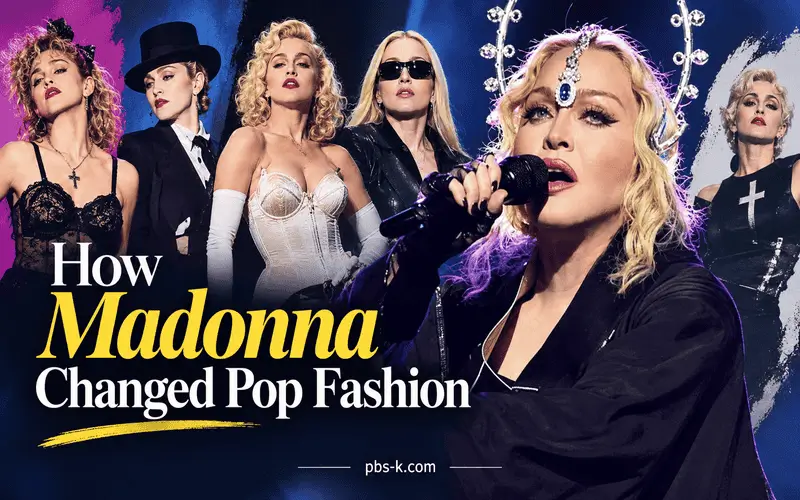
Madonna helped demonstrate that a pop artist could use fashion as an active part of storytelling. Her looks were often designed to create a strong visual impression and reinforce the personality of a song or performance.
Her collaborations with designers and stylists also helped bring runway fashion and alternative style influences into mainstream pop culture.
She has frequently changed her appearance rather than relying on one signature look. That approach helped make reinvention part of her public identity.
Her Influence on Music Videos
Madonna treated music videos as creative projects rather than simple recordings of a performance. Choreography, costumes, editing, cinematography, and symbolism worked together to give her songs a distinctive visual identity.
Videos such as “Like a Prayer” and “Vogue” became widely discussed cultural works. Their imagery, alongside the music itself, helped keep audiences engaged with her artistic choices.
Her career also helped establish a model for pop performers who wanted greater control over their public image and creative presentation.
Her Role in Cultural Conversations
Madonna has often addressed subjects that have generated public debate, including sexuality, religion, gender roles, and personal freedom.
Some of her work has been praised for challenging social restrictions, while other projects have attracted criticism over their imagery or approach. Understanding her influence means recognizing both the artistic impact of her work and the disagreements it has sometimes created.
Her legacy is therefore more complex than a list of hit singles. It includes the conversations that her music and performances helped bring into mainstream culture.
Madonna’s Awards and Major Achievements
Madonna’s career includes major commercial successes, industry recognition, and a lasting influence on pop music.
Some of her most significant achievements include:
- Rock & Roll Hall of Fame: She was inducted in 2008. The institution recognizes her role in changing pop music and expanding the possibilities of performance and visual presentation. Rock & Roll Hall of Fame
- Grammy Awards: Madonna has received multiple Grammy Awards over her career, including recognition for Ray of Light.
- Golden Globe Award: She won Best Actress in a Motion Picture, Musical or Comedy for Evita.
- Music chart success: Songs such as “Like a Virgin,” “Like a Prayer,” “Vogue,” and “Music” became major international hits.
- Dance music influence: Her work helped bring club sounds, electronic production, and dance-oriented albums to a broad pop audience.
- Music video innovation: Her videos and performances helped strengthen the relationship between music, fashion, choreography, and visual storytelling.
Awards are one way to measure an artist’s achievements, but they do not tell the whole story. Madonna’s continued presence in discussions about pop music, fashion, performance, and artistic independence is also a major part of her legacy.
For a complete and current award tally, readers should consult the official award organizations, as nominations and wins can be updated over time.
Madonna’s Family and Personal Life
Madonna’s personal life has received considerable public attention throughout her career. However, her family relationships and experiences as a parent are also important parts of her life beyond music.
She was born to Madonna Fortin and Silvio Ciccone and grew up with several siblings. Her early family experiences, particularly the death of her mother, have been discussed in accounts of her life and creative development.
Madonna has six children. Her family includes Lourdes Leon, her daughter with Carlos Leon, and Rocco Ritchie, her son with filmmaker Guy Ritchie. She also adopted four children from Malawi: David Banda, Mercy James, and twins Stella and Estere.
She has generally maintained a degree of privacy around her children’s lives, although some of her family members have pursued careers in music, fashion, and other creative fields.
Madonna’s relationships and marriages have also attracted attention. She was married to actor Sean Penn in the 1980s and later to Guy Ritchie, with whom she shares Rocco.
While public interest in celebrity relationships is understandable, details about private matters should be treated carefully. Verified information is more useful than speculation, especially when reporting on family members who have not chosen the same level of public visibility.
How to Start Listening to Madonna’s Music
With a career spanning several decades, Madonna has a large catalogue that can be difficult for new listeners to explore. The easiest approach is to begin with a few representative songs and then move into complete albums.
A beginner’s listening guide
1. Start with the greatest hits
Try The Immaculate Collection for an introduction to many of her best-known songs from the 1980s and early 1990s.
2. Explore her songwriting
Listen to Like a Prayer to hear how she combined catchy pop melodies with more personal and challenging themes.
3. Discover her electronic side
Try Ray of Light for atmospheric production, introspective lyrics, and a different approach to pop music.
4. Follow the dance sound
Listen to Confessions on a Dance Floor, followed by Confessions II, to compare her dance-oriented work across two decades.
To get more from the experience, compare the original recordings with official music videos and live performances. Notice how the arrangements, choreography, and visual themes change from one era to another.
You can find her discography and official listening links on the Madonna music page. Streaming availability varies by country and service.
FAQs
Who Is Madonna?
Madonna is an American singer, songwriter, actress, and record producer widely known as the Queen of Pop. She became an international star during the 1980s and is recognized for her hit songs, changing musical styles, and influence on fashion and popular culture.
What Is Madonna’s Real Name?
Madonna’s full birth name is Madonna Louise Ciccone. She performs professionally under the name Madonna.
How Old Is Madonna?
Madonna was born on August 16, 1958. As of October 18, 2026, she is 68 years old.
What Are Madonna’s Most Famous Songs?
Some of her best-known songs include “Like a Virgin,” “Like a Prayer,” “Vogue,” “Material Girl,” “Papa Don’t Preach,” “Express Yourself,” “Frozen,” “Music,” and “Hung Up.”
What Is Madonna’s Latest Album?
Her latest studio album is Confessions II, released on July 3, 2026. It continues the dance-focused direction of her 2005 album Confessions on a Dance Floor.
How Many Albums Has Madonna Released?
Madonna’s fifteenth studio album, Confessions II, was released in July 2026. Her catalogue also includes compilations, soundtracks, remix collections, and live albums, so the total number of releases depends on which categories are counted.
How Many Children Does Madonna Have?
Madonna has six children: Lourdes Leon, Rocco Ritchie, David Banda, Mercy James, Stella Ciccone, and Estere Ciccone.
Why Is Madonna Called the Queen of Pop?
She earned the nickname through her lasting success in pop music, influential music videos, memorable performances, and ability to adapt to new musical trends. Her career has also influenced fashion, visual performance, and discussions about artistic freedom.
Did Madonna Act in Movies?
Yes. She appeared in films including Desperately Seeking Susan, Dick Tracy, A League of Their Own, Evita, and Swept Away. Her performance in Evita earned her a Golden Globe Award for Best Actress in a Motion Picture, Musical or Comedy.
Is Madonna in the Rock & Roll Hall of Fame?
Yes. Madonna was inducted into the Rock & Roll Hall of Fame in 2008 in the Performer category.
Where Can I Listen to Madonna’s Music?
You can explore her music through services such as Apple Music and Spotify, depending on regional availability. Her official website also provides links to music, releases, and related content.
Conclusion
Madonna’s career demonstrates how music, fashion, performance, and creative reinvention can come together to shape popular culture. From her early breakthrough in the 1980s to albums such as Like a Prayer, Ray of Light, and Confessions on a Dance Floor, she has continued to explore new sounds and artistic ideas.
Her influence extends beyond commercial success. Her music videos, live shows, and willingness to challenge expectations have helped make her one of pop music’s most recognizable figures.
With Confessions II released in 2026, Madonna continues to build on her long relationship with dance music. Readers who want to understand her legacy can start with her greatest hits, explore the albums that defined different stages of her career, and follow verified updates through her official channels.
External Sources
Madonna’s Official Website. Best for official announcements, album releases, music, and career updates.
Rock & Roll Hall of Fame: Madonna. Useful for her 2008 induction, musical development, signature songs, and influence.