
Introduction
Finding a registered agent is usually easier than it sounds. In most cases, you can locate the information by searching the business’s public record through the Secretary of State or another state business-registration agency.
A registered agent is the person or organization designated to receive official documents, including service of process and certain government notices, for a business. The exact terminology and search process vary by state. For example, California commonly uses the term “agent for service of process,” while other states use “registered agent.”
If you need to know how to find a registered agent, the most reliable approach is to start with the state where the business is registered, find its official business-search tool, search for the company, and review the entity record.
What Is a Registered Agent?
A registered agent is an individual or business designated to receive legal documents and certain official communications on behalf of a business entity.
The role is closely connected to service of process. If a company is sued, for example, legal papers may be served through the registered agent according to applicable state law.
Registered-agent requirements are state-specific. Delaware requires entities to maintain a registered agent with a physical Delaware office, while Washington requires a registered agent with a physical address in Washington. Oregon similarly requires a registered agent with a physical street address in the state.
The registered agent is not necessarily the business owner. It can be:
- An owner or other individual who meets state requirements
- An officer, manager, or employee
- An attorney or accountant
- A professional registered-agent company
- Another qualifying business entity, depending on state law
The rules about who may serve as an agent differ by state, so do not assume that a person or company qualifies simply because they have a business address in that state.
How to Find a Registered Agent
The easiest method is to search the official business records maintained by the state.
Follow these steps.
1. Identify the Business’s State
First, determine which state the business is registered in.
Look for clues such as:
- The company’s formation documents
- Its website or legal notices
- State business registration records
- Contracts or invoices
- The company’s principal office information
- A state identification or filing number
Do not automatically assume that the business’s physical location is the same as its state of formation.
A company can be formed in one state and later register to do business in another state. The U.S. Small Business Administration explains that businesses operating in multiple states may need foreign qualification in additional states.
2. Find the Official State Business Search
Once you know the state, locate its official business-entity search.
In many states, this is operated by the Secretary of State. Some states use another government agency or business-registration division.
The SBA maintains a state registration lookup that directs users to the appropriate state registration website.
When possible, use the government database rather than relying on a third-party business directory.
3. Search for the Business Name
Enter the company’s legal name into the state business search.
Use the exact legal entity name if you have it. A brand name, website name, or trade name may not match the company’s registered legal name.
If the first search does not work, try:
- Removing punctuation
- Searching a shorter version of the name
- Searching the company’s entity or registration number
- Trying alternative spacing
- Checking whether “LLC,” “Inc.,” “Corp.,” or another suffix is included
Some state databases offer several search methods.
For example, Georgia’s official business search can be searched by business name, control number, registered agent name, officer name, and other fields.
4. Open the Correct Business Record
Search results can contain multiple companies with similar names.
Before using the registered-agent information, compare details such as:
- Legal business name
- Entity type
- Registration or formation date
- State of formation
- Business identification number
- Current status
- Principal or mailing address
This helps prevent confusing two businesses with similar names.
For example, New York’s Department of State says its business records can include the entity name, organization date, jurisdiction, county, service-of-process address, registered agent if one exists, and current status. The records are updated daily.
5. Look for the Registered Agent Field
After opening the business record, look for a field labeled something like:
- Registered Agent
- Registered Agent Name
- Registered Office
- Agent for Service of Process
- Statutory Agent
- Agent for Service
- Service of Process Address
The terminology varies.
California, for example, uses “agent for service of process.” Its Secretary of State says the Business Search provides the name and address of the agent for service of process for applicable business entities.
Oregon’s business records can show the registered agent name and address.
6. Record the Agent’s Information
Depending on the state and entity, the record may provide:
- Agent’s name
- Registered office address
- Mailing address
- Business entity number
- Entity status
- Filing information
- Other public business details
Record the information exactly as it appears in the official record.
If you need the information for a legal proceeding, do not rely on an old search result or an unofficial directory. Verify the current state record before taking action.
7. Check the Entity’s Current Status
Do not stop after finding a name.
Check whether the business is listed as:
- Active
- In good standing
- Delinquent
- Suspended
- Administratively dissolved
- Inactive
- Revoked
- Withdrawn
The exact status terms vary by state.
A registered-agent entry associated with an inactive or dissolved entity may not have the same practical significance as an active entity.
Delaware, for example, warns that its basic entity search can return both active and inactive entities, so users should not treat the search result itself as proof of current status.
How to Find Your Own Registered Agent
If you own a business and simply need to find the registered agent currently listed for your company, there are several places to check.
Check Your State Business Record
This is usually the best starting point.
Search your business on the official state website and open its current record. Look for the registered-agent or agent-for-service-of-process section.
For example, California’s online business records include the agent’s name and address, while Oregon’s active business registration search provides registered-agent information.
Check Your Formation Documents
Your Articles of Organization, Articles of Incorporation, Certificate of Formation, or similar document may contain the registered agent information submitted when the company was formed.
However, do not assume that information is still current.
A business can change its registered agent after formation. The current state database is therefore important when you need the latest information.
Check Annual Reports and Amendments
Registered-agent information may also appear in annual reports or amendment filings.
If your company changed agents, check the most recent filing rather than relying on the original formation paperwork.
Check Your Registered-Agent Service Account
If you hired a professional registered-agent company, your account or service agreement may identify the agent.
Still, compare the information with the state record if accuracy matters.
How to Find a Registered Agent by Company Name
If you know the business name but not its registered agent, the process is straightforward:
- Identify the state where the business is registered.
- Open the state’s official business search.
- Search the company’s legal name.
- Select the correct entity.
- Open the entity details.
- Find the registered-agent or service-of-process field.
- Record the agent’s name and address.
- Check the entity’s current status.
This method is generally more reliable than searching Google for the company’s name followed by “registered agent.”
The reason is simple: the state business registry is the source where the company’s registration information is filed.
Can You Find a Registered Agent by Name?
Sometimes, yes.
Whether you can search directly by the agent’s name depends on the state.
Georgia’s business-search system, for example, includes a Registered Agent Name search field.
Washington also provides an advanced search that can be used to find businesses associated with a particular registered agent. Its instructions specifically direct users to the Registered Agent/Governor Search section.
Other states may only allow searches by business name, entity number, or other criteria.
If the state does not offer a registered-agent-name search, you may need to search individual business records.
How to Find a Registered Agent’s Address
The registered agent’s address is normally part of the business registration record when state law requires that information to be filed.
Look for the registered office or agent address rather than assuming it is the company’s main office.
A registered office is often a physical address where the agent is available to receive service of process. For example, Washington requires a registered agent to maintain a physical Washington address and does not allow a PO box or private mailbox as the registered-agent address.
The registered-agent address can therefore be different from:
- The company’s headquarters
- Its principal office
- Its mailing address
- Its owner’s home address
- Its place of business
The IRS also distinguishes a company’s principal office from its registered-agent address in its instructions for certain tax forms.
What If the Registered Agent Is a Company?
A registered agent does not have to be an individual.
Many businesses use professional registered-agent services. Depending on state law, another qualifying business entity may also serve as the agent.
For example, Delaware allows an individual resident or an authorized business entity to serve as a registered agent, subject to its state requirements.
If the record lists a company, use the registered agent’s legal name as it appears in the state record.
Do not assume that the registered agent company is the same company as the business you are researching.
What If You Cannot Find the Registered Agent?
There are several possible reasons.
The Business Name Is Incorrect
The company may be registered under a different legal name.
Try searching without punctuation or business suffixes, or use the entity number if available.
You Are Searching the Wrong State
A business may operate in one state while being legally organized in another.
It may also be registered as a foreign entity in the state where it operates.
The State Uses Different Terminology
Try searching for terms such as:
- Agent for service of process
- Statutory agent
- Service agent
- Registered office
- Service of process
California, for example, uses “agent for service of process” rather than relying exclusively on the phrase “registered agent.”
The Entity Is Inactive
Some state searches include inactive businesses. Delaware specifically notes that its entity search returns both active and inactive entities.
Check the current entity status before relying on the information.
The Database Has Limited Coverage
Not every business type appears in every state database.
California, for example, says its Business Search currently does not contain records for certain entity types, including some partnerships and associations.
If the state database does not contain the type of organization you are looking for, check the appropriate government agency or contact the state office.
How to Verify Registered Agent Information
Finding a name is only the first step. Verification is especially important if you need the information for legal or compliance purposes.
Use this checklist:
| What to Check | Why It Matters |
|---|---|
| Legal entity name | Confirms you found the right business |
| Entity number | Helps distinguish similarly named companies |
| Entity status | Shows whether the business is currently active |
| Registered agent name | Identifies the designated agent |
| Registered office | Shows where the agent is located |
| Filing date | Helps establish how current the record is |
| State source | Confirms the information comes from the relevant government registry |
If the information will be used for serving legal papers, consider obtaining professional legal guidance rather than relying solely on an online search.
Oregon’s Secretary of State specifically notes that service of process is an important legal proceeding and recommends contacting an attorney or licensed process server for assistance with legal service questions.
Registered Agent vs. Business Address
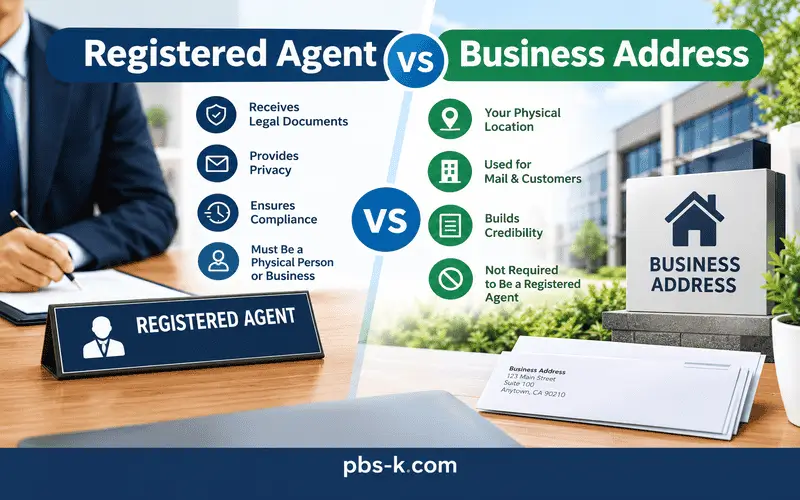
A common mistake is treating these as the same thing.
They can be different.
A business may have:
- A principal business address
- A mailing address
- A registered office
- A registered agent’s address
The registered agent’s address exists for the statutory purpose of receiving documents and notices covered by state law.
For example, Delaware says the registered office may, but does not have to, be the same as the entity’s place of business.
This is why searching the company’s website or Google Maps may not tell you who its registered agent is.
Registered Agent vs. Owner
The registered agent and business owner are also not necessarily the same person.
A professional agent service may represent hundreds or thousands of companies.
State records may identify the registered agent without identifying all owners.
Texas, for example, notes that its Secretary of State maintains registered-agent and registered-office information but does not maintain general ownership information for LLCs.
Therefore, finding the registered agent does not automatically tell you who owns the company.
Is a Registered Agent Public Information?
In many states, registered-agent information is part of the public business record.
The precise information available varies by jurisdiction.
New York says its business records can include the registered agent and service-of-process address. California provides agent-for-service-of-process information through its business search, and Oregon says registered-agent information is a matter of public record.
However, “public” does not mean every piece of information about the person or business will be available.
A state may restrict access to certain records or omit information that it does not maintain.
Should You Use a Third-Party Registered Agent Search?
Third-party websites can sometimes make business research easier, especially when you are comparing multiple companies or states.
However, use them as a convenience rather than your final authority.
The safest workflow is:
Third-party search → identify the business → verify against the official state record.
Government databases can change, and third-party directories may contain outdated information.
The SBA provides a state-by-state registration lookup to help users reach the appropriate government registration website.
How to Choose a Registered Agent for Your Business
If you are not trying to find an existing agent but need to choose one for your own business, start with your state’s requirements.
Common considerations include:
- Physical address requirement
- Availability during required business hours
- Privacy
- Mail and document handling
- Compliance reminders
- Multi-state coverage
- Annual service fees
- Additional charges
- Ease of changing agents
A professional service can be useful when you do not have a suitable physical address, operate in multiple states, or want someone else to handle service-of-process documents.
You do not necessarily need to pay a third party, however. Oregon, for example, explains that many businesses can designate a qualifying owner, officer, or employee instead.
The correct choice depends on your state’s rules and your business’s needs.
What to Do After Finding the Registered Agent
What you do next depends on why you searched.
If you are researching a company, save the entity record and note the date you checked it.
If you are a business owner, compare the record with your internal formation documents and confirm that the information is current.
If you need to serve legal documents, follow the applicable service-of-process rules. Finding an address online is not necessarily the same as completing valid legal service.
If you discover an incorrect or outdated registered-agent listing for your company, contact the appropriate state filing office and follow its procedure for changing the agent.
Common Mistakes When Looking Up a Registered Agent
Avoid these common errors:
Searching Only on Google
Search engines may show outdated directories or unrelated companies.
Start with the state business registry.
Using a Brand Name Instead of the Legal Name
A website may use a brand that is different from the registered entity.
Look for the legal entity name.
Assuming the Agent Is the Owner
The registered agent may be an attorney, service company, employee, or another qualifying person or entity.
Confusing the Registered Office With Headquarters
The registered office exists for the registered-agent function and may differ from the company’s principal office.
Ignoring Entity Status
An old business record may not reflect the current status of an entity.
Relying on an Old Screenshot
Registered agents can change. Use the current state record whenever the information matters.
Assuming Every State Works the Same Way
State terminology, search tools, eligibility rules, and public-record availability differ.
That is why a state-specific check is essential.
A Quick Registered Agent Lookup Checklist
If you need the answer quickly, use this process:
- Identify the state.
- Find the official business registry.
- Search the legal business name.
- Select the correct entity.
- Confirm the entity number and status.
- Find the registered agent or service-of-process field.
- Record the agent’s name and address.
- Check the date or current filing information.
- Verify the information directly with the state if the matter is important.
- Get legal advice when the search relates to formal service of process or litigation.
The SBA’s state registration lookup is a useful starting point if you are unsure which state agency to use.
FAQs
How do I find a registered agent?
Search the official business-record database for the state where the company is registered. Search the company’s legal name, open the correct entity record, and look for the registered agent, agent for service of process, or similar field.
Can I find a registered agent by company name?
Yes. In many states, you can search the business’s legal name through the Secretary of State or another state registration database. The available search fields differ by state.
Can I find a registered agent by name?
Sometimes. Some states provide a registered-agent-name search. Georgia and Washington, for example, provide search options that can identify businesses associated with a registered agent.
Is a registered agent the same as the business owner?
No. A registered agent can be an owner, employee, attorney, professional service company, or another qualifying person or entity, depending on state law.
Is the registered agent’s address public?
Registered-agent information is often part of a state’s public business records, although the exact information available varies by state. Oregon, California, and New York are examples of states that make registered-agent or agent-for-service information available through business records.
Can I use the registered agent’s address as the company’s main address?
Not necessarily. A registered-agent address and a company’s principal business address can be different. The purpose of the registered office is generally connected to receiving documents and service of process.
What if I cannot find the company’s registered agent?
Check that you are searching the correct state and the company’s legal name. Also look for alternative terms such as “agent for service of process” or “statutory agent.” If the entity is not in the state database, check whether its entity type is covered by that state’s online search system.
Do I have to hire a registered agent service?
Not always. State requirements determine who can serve as a registered agent. In some states, a qualifying owner, officer, employee, or individual can serve in the role.
Is a registered agent responsible for running the business?
No. The registered agent’s primary statutory role is receiving documents and notices covered by the state’s registered-agent rules. It does not mean the agent owns or manages the company.
Is finding a registered agent enough to serve legal papers?
Not necessarily. Formal service of process is governed by applicable law and court rules. If the search is connected to a lawsuit or other legal proceeding, consider consulting an attorney or qualified process server.
Conclusion
Learning how to find a registered agent usually comes down to using the correct state business registry. Identify the company’s state, search its legal entity name, open the correct business record, and review the registered-agent or agent-for-service-of-process information.
Because state terminology and database features vary, always verify important information against the current official state record. If your search relates to litigation, service of process, or another legal matter, use the applicable legal procedure rather than relying only on an online lookup.
External Sources
U.S. Small Business Administration: State Registration Lookup — useful for directing readers to the correct state business-registration agency.
SBA: Launch Your Business and Registered Agent Guidance — supports the explanation of registered agents and state registration.