
Introduction
Clint Eastwood is an American actor, director, producer, and musician whose career has helped shape modern Hollywood. Born on May 31, 1930, in San Francisco, California, he became famous for playing tough, independent characters in Western films and crime dramas. Over time, he also earned widespread recognition as a director, creating award-winning movies that explore human relationships, difficult choices, justice, and redemption.
From the television series Rawhide to iconic films such as The Good, the Bad and the Ugly, Dirty Harry, Unforgiven, and Million Dollar Baby, Eastwood has built a career spanning more than six decades. He is known not only for his screen presence but also for his work behind the camera.
His achievements extend beyond entertainment. Eastwood served as mayor of Carmel-by-the-Sea, California, from 1986 to 1988, and his production company, Malpaso Productions, has played an important role in his filmmaking career. His story offers an interesting look at how an actor can develop into one of Hollywood’s most recognized directors.
Who Is Clint Eastwood?
Clint Eastwood is an American filmmaker best known for his Westerns, crime thrillers, and award-winning dramas. He gained international fame through Sergio Leone’s Western films in the 1960s before becoming a major Hollywood star with the Dirty Harry series.
Eastwood later established himself as a director and producer. His films Unforgiven and Million Dollar Baby earned him Academy Awards for both Best Director and Best Picture. These achievements helped establish his reputation as a filmmaker capable of working across different genres.
Here are some important facts about his life and career.
| Detail | Information |
|---|---|
| Full name | Clinton Eastwood Jr. |
| Date of birth | May 31, 1930 |
| Birthplace | San Francisco, California, United States |
| Nationality | American |
| Profession | Actor, director, producer, musician |
| Famous television role | Rowdy Yates in Rawhide |
| Iconic film role | Harry Callahan in Dirty Harry |
| Production company | Malpaso Productions |
| Political office | Mayor of Carmel-by-the-Sea, 1986 to 1988 |
| Notable awards | Academy Awards for Best Director and Best Picture |
Eastwood’s career is particularly interesting because he succeeded in two demanding areas of filmmaking. He became a recognizable screen actor while also developing a long career directing and producing films.
Early Life and Family Background
Clint Eastwood was born to Clinton Eastwood Sr. and Ruth Wood. During his childhood, his family moved around California before settling in Piedmont, near Oakland. His early years were not spent in the film industry, and his route to Hollywood included several ordinary jobs.
Before becoming an actor, Eastwood worked in different occupations, including jobs connected with logging, construction, and other manual work. These experiences came before his eventual entry into professional entertainment.
After graduating from high school, he spent time in the Pacific Northwest before returning to California. In the early 1950s, he served in the United States Army and was stationed at Fort Ord, where he worked as a swimming instructor.
Following his military service, Eastwood pursued opportunities in acting. He attended classes at Los Angeles City College and eventually secured a film contract.
His early career involved small roles rather than immediate stardom. These first experiences gave him an opportunity to learn how film production worked and gradually build his professional reputation.
How Clint Eastwood Became Famous
Eastwood’s rise to fame happened in stages. Television introduced him to a broad audience, Italian Westerns made him internationally recognizable, and Hollywood crime films helped establish his lasting popularity.
His Breakthrough in Rawhide
Eastwood gained significant attention in 1959 when he joined the television Western Rawhide. He played Rowdy Yates, a young cowboy working with a cattle-driving crew.
The series ran for several seasons and helped Eastwood develop the screen presence that later became his trademark. His tall frame, restrained acting style, and ability to portray confident but complicated characters made him a natural fit for Western stories.
Although he appeared in films before Rawhide, the television series provided the kind of consistent exposure that smaller movie roles had not offered.
The Dollars Trilogy
Eastwood reached international stardom through three Western films directed by Italian filmmaker Sergio Leone.
The films are commonly known as the Dollars Trilogy:
- A Fistful of Dollars (1964)
- For a Few Dollars More (1965)
- The Good, the Bad and the Ugly (1966)
Eastwood played the largely unnamed gunslinger often called the Man with No Name. The character was quiet, observant, resourceful, and morally ambiguous.
These films helped popularize the spaghetti Western, a term used for Westerns produced by Italian filmmakers, often with international casts and production teams. Their visual style, dramatic music, tense confrontations, and morally complicated characters differed from many traditional American Westerns.
The trilogy transformed Eastwood from a television actor into an international movie star. It also established the screen persona that audiences would associate with him for decades.
Clint Eastwood’s Most Famous Movies
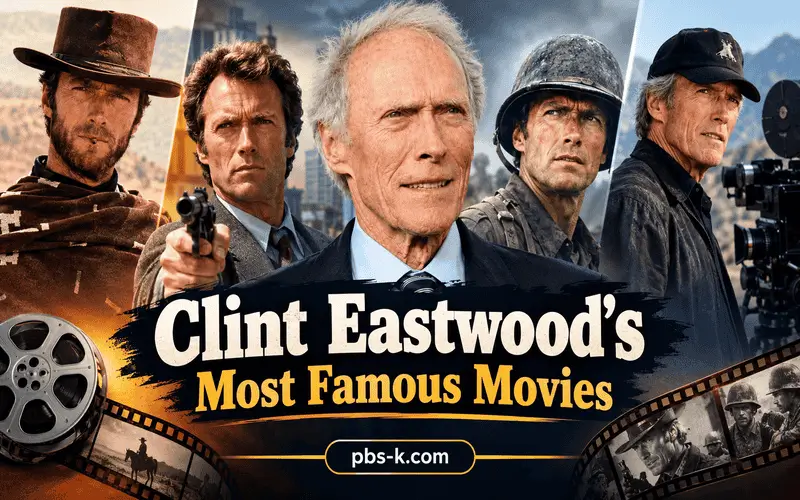
Eastwood has appeared in numerous films as an actor and directed many more. His best-known work includes Westerns, crime thrillers, dramas, romantic stories, and films based on real events.
The following titles provide a useful starting point for anyone exploring his filmography.
The Good, the Bad and the Ugly (1966)
This Western follows three men competing to find buried gold during the American Civil War. Eastwood plays Blondie, a skilled gunslinger whose choices are shaped by survival, money, and shifting alliances.
The film is widely recognized for its memorable musical score, long suspenseful sequences, and distinctive visual style. It remains one of Eastwood’s defining performances and an important work in Western cinema.
Dirty Harry (1971)
In Dirty Harry, Eastwood plays Harry Callahan, a San Francisco police inspector known for his hard-edged methods and confrontational personality.
The film became a major commercial success and helped establish Eastwood as a leading action star. Its portrayal of crime, policing, and justice also generated debate, making it a notable example of how popular films can reflect broader social concerns.
The success of the original film led to four sequels, extending the character’s place in popular culture.
The Outlaw Josey Wales (1976)
This Western follows a Missouri farmer who becomes a fugitive after suffering a devastating personal loss during the Civil War era.
Eastwood stars as Josey Wales, a character driven by revenge who gradually forms connections with other outsiders. The story combines action with themes of grief, loyalty, survival, and the possibility of rebuilding a life after violence.
The film is also important in Eastwood’s development as a director, demonstrating his growing interest in stories that explore the emotional consequences of conflict.
Escape from Alcatraz (1979)
In this prison drama, Eastwood portrays Frank Morris, an inmate involved in the famous 1962 escape attempt from Alcatraz Federal Penitentiary.
Directed by Don Siegel, the film emphasizes planning, patience, and the practical challenges of escaping a heavily secured prison. Its controlled performances and tense atmosphere make it one of Eastwood’s notable crime dramas.
Unforgiven (1992)
Unforgiven is one of Eastwood’s most important films as both an actor and director. He plays William Munny, a former gunfighter who returns to violence after accepting a bounty-hunting job.
Rather than presenting the Old West as a simple world of heroes and villains, the film questions the mythology of the gunfighter. It examines violence, reputation, regret, and the human cost of revenge.
The film won Academy Awards for Best Picture and Best Director, along with awards in other categories. It is frequently discussed as a major revisionist Western because it challenges the heroic image often associated with traditional Western characters.
The Bridges of Madison County (1995)
Eastwood moved away from his familiar action persona in this romantic drama, co-starring with Meryl Streep.
The story follows a married Iowa woman whose life changes after she meets a traveling photographer. The film focuses on love, responsibility, missed opportunities, and the difficult decisions people make when personal desires conflict with family commitments.
It demonstrated that Eastwood could direct and star in a quiet, emotionally focused film without relying on action or suspense.
Mystic River (2003)
Eastwood directed this crime drama about three childhood friends whose lives become connected by a murder investigation.
The film features Sean Penn, Tim Robbins, and Kevin Bacon. It explores trauma, grief, suspicion, and the long-term effects of childhood experiences.
The performances received considerable recognition, and Penn and Robbins each won an Academy Award for their roles. The film also strengthened Eastwood’s reputation as a director of serious dramatic stories.
Million Dollar Baby (2004)
In Million Dollar Baby, Eastwood plays Frankie Dunn, an experienced boxing trainer who reluctantly agrees to train an ambitious woman played by Hilary Swank.
Morgan Freeman appears as Dunn’s longtime friend and assistant. The film examines ambition, mentorship, family relationships, personal dignity, and difficult moral decisions.
It won four Academy Awards, including Best Picture and Best Director for Eastwood. Swank won Best Actress, while Freeman won Best Supporting Actor.
The film is an essential choice for viewers who want to understand why Eastwood is respected as a dramatic filmmaker rather than only as an action star.
Gran Torino (2008)
Eastwood directed and starred in Gran Torino as Walt Kowalski, a retired factory worker who has become isolated from much of his family and community.
His relationship with a young Hmong American neighbor gradually challenges his assumptions and changes how he sees responsibility and belonging.
The film addresses prejudice, cultural differences, loyalty, and personal transformation. It also became one of Eastwood’s most recognizable later acting roles.
American Sniper (2014)
Eastwood directed this biographical war drama about American Navy SEAL sniper Chris Kyle, played by Bradley Cooper.
The film follows Kyle’s military service and the effects of war on his life and family. It generated substantial public discussion about military service, trauma, and the portrayal of modern warfare.
For viewers interested in Eastwood’s work outside Westerns and crime dramas, it offers an example of his approach to large-scale historical and military subjects.
Juror #2 (2024)
Juror #2 is a legal thriller directed by Eastwood and starring Nicholas Hoult. The story centers on a juror who faces a serious moral conflict while serving on a murder trial.
The film explores uncertainty, responsibility, and the tension between personal knowledge and the legal process. It also illustrates Eastwood’s continued work behind the camera in his later career.
For readers interested in his more recent filmmaking, it is an important title to add to the list.
Clint Eastwood as a Director
Eastwood’s directing career is a major part of his legacy. He made his feature directorial debut with Play Misty for Me (1971), a psychological thriller in which he also starred.
The film showed that he was interested in stories beyond Westerns and action movies. It also marked the beginning of a directing career that would include dramas, comedies, biographical films, war stories, and crime thrillers.
Over time, Eastwood became known for a relatively restrained approach to filmmaking. His movies often rely on clear storytelling, controlled performances, naturalistic dialogue, and focused scenes rather than elaborate visual effects.
His production company, Malpaso Productions, has been central to his work. By producing many of his own films, Eastwood helped maintain continuity between his creative choices and the finished projects.
What Makes His Directing Style Distinctive?
Several characteristics help explain Eastwood’s approach to directing.
1. Simple, focused storytelling
His films often keep the central conflict clear. Even when the subject is complicated, the audience can usually follow the decisions and consequences facing the main characters.
2. Strong character development
Many of his stories follow people who carry regret, make mistakes, or struggle with difficult past experiences. The drama comes from how these characters respond to their circumstances.
3. Interest in moral complexity
Eastwood frequently explores the difference between what people believe is right and what their actions actually mean. Unforgiven, Mystic River, and Million Dollar Baby are useful examples.
4. Work across different genres
Although he is closely associated with Westerns, he has directed romantic dramas, thrillers, war films, comedies, and biographical stories.
5. A long-term creative partnership with his production company
Malpaso Productions has supported much of his filmmaking career, giving him a consistent production base across many decades.
These features do not mean every Eastwood film follows the same formula. Rather, they help explain the recurring interests that connect otherwise different projects.
Clint Eastwood’s Academy Awards and Major Achievements
Eastwood’s awards recognize both his acting and his work behind the camera. His two Best Picture and Best Director victories are especially significant because they demonstrate his achievements as a filmmaker, not just a screen performer.
His major Academy Award milestones include:
| Film or achievement | Recognition |
|---|---|
| Unforgiven (1992) | Won Best Picture and Best Director |
| Mystic River (2003) | Received Best Picture and Best Director nominations |
| Million Dollar Baby (2004) | Won Best Picture and Best Director |
| Letters from Iwo Jima (2006) | Received a Best Picture nomination |
| American Sniper (2014) | Received a Best Picture nomination |
Eastwood also received major recognition from organizations outside the Academy Awards. His honors include the American Film Institute’s Life Achievement Award, the Cecil B. DeMille Award, and the Screen Actors Guild Life Achievement Award.
These distinctions reflect the breadth of his career. He has contributed to Hollywood as an actor, director, producer, and musician over an unusually long period.
Clint Eastwood’s Family and Personal Life
Eastwood has generally kept much of his private life separate from his public career, although his relationships and family have received media attention over the years.
He has been married twice. His first marriage was to Margaret Neville Johnson, commonly known as Maggie Johnson, whom he married in 1953. His second marriage was to television presenter Dina Ruiz, later known as Dina Eastwood, in 1996. Their marriage ended in divorce in 2014.
Public reporting identifies eight children: Laurie, Kimber, Kyle, Alison, Scott, Kathryn, Francesca, and Morgan. Several of his children have worked in entertainment, although they have pursued different careers.
Kyle Eastwood is known for his work as a jazz musician and composer. Alison Eastwood has worked as an actor and filmmaker, while Scott Eastwood has developed an acting career of his own.
Eastwood has also had long-term relationships outside his marriages. Christina Sandera, his partner in later life, died in July 2024. Because he tends to keep his private affairs out of the spotlight, it is best to distinguish confirmed public information from speculation about his personal relationships.
Does Clint Eastwood Have Children in Hollywood?
Yes. Several of Eastwood’s children have pursued work in film, television, or music.
Scott Eastwood has appeared in films including The Longest Ride, Suicide Squad, and The Fate of the Furious. Kyle Eastwood has established himself in jazz, including work as a bassist and composer. Alison Eastwood has worked both in front of and behind the camera.
Their careers have taken different paths, so it would be inaccurate to assume that all of Eastwood’s children work as actors or have followed the same professional route.
Clint Eastwood’s Political Career
Eastwood’s public life has extended beyond entertainment. In 1986, he was elected mayor of Carmel-by-the-Sea, a coastal community in California.
He served for two years, leaving office in 1988. His time as mayor was relatively brief compared with his film career, but it remains an unusual chapter in the life of a major Hollywood star.
The position also reflected his connection to the Carmel area, where he has long been associated with local life and business.
His political involvement is best understood as one part of a wider career rather than the main reason for his fame. His lasting public recognition comes primarily from his work in movies and filmmaking.
Clint Eastwood’s Music and Other Interests
Music has been another part of Eastwood’s creative life. He has a longstanding interest in jazz and has contributed to music for some of his films.
His film Bird (1988), a biographical drama about jazz saxophonist Charlie Parker, reflects this interest. Rather than treating music as a background detail, the film places the musician’s talent, personal struggles, and artistic development at the center of the story.
Eastwood has also composed or contributed music to several film projects. His connection with jazz has continued through his family, particularly his son Kyle Eastwood, who works as a musician and composer.
This musical interest adds another dimension to his career and helps explain why his creative work extends beyond acting and directing.
Clint Eastwood’s Latest Film and Current Career
One of Eastwood’s most recent feature films as a director is Juror #2, released in 2024. The courtroom thriller stars Nicholas Hoult alongside Toni Collette, J.K. Simmons, and other cast members.
The project attracted attention because Eastwood continued directing major feature films in his 90s. It also returned to familiar themes in his work, including moral responsibility, difficult choices, and the consequences of personal decisions.
Eastwood has maintained a lower public profile in recent years. Readers looking for news about a new film, retirement announcement, or upcoming project should check recent statements from his representatives, production companies, or established entertainment publications. An announced project should not be treated as a completed or released film without confirmation.
His long career makes it tempting to focus only on his age or longevity, but his filmmaking achievements provide a more useful way to understand his continuing influence.
Why Clint Eastwood Remains Important to Hollywood
Eastwood’s influence comes from more than his famous characters. His career demonstrates how an actor can develop a distinctive screen identity and then use that experience to build a successful directing career.
His Westerns helped change the style of the genre, particularly through their morally complicated heroes and more confrontational storytelling. His crime films shaped the image of the hard-edged action protagonist, while his later dramas explored vulnerability, regret, and difficult ethical questions.
As a director, he has also demonstrated that a recognizable creative style can work across several genres. The Bridges of Madison County differs greatly from Dirty Harry, yet both films reflect an interest in characters facing difficult personal choices.
His Academy Award-winning work further strengthened his reputation as a filmmaker. Unforgiven challenged familiar Western myths, while Million Dollar Baby showed his ability to direct emotionally demanding drama.
For new viewers, the best way to understand Eastwood’s legacy is to watch films from different stages of his career. Comparing his early Westerns with his later dramas reveals how his interests and filmmaking methods developed over time.
Conclusion
Clint Eastwood has built an extraordinary career as an actor, director, and producer. From his early television success in Rawhide to internationally recognized Westerns and award-winning dramas, he has remained an important figure in American cinema.
His work on Unforgiven, Million Dollar Baby, Mystic River, and Gran Torino demonstrates his range as a filmmaker, while his performances in Dirty Harry and The Good, the Bad and the Ugly remain central to his screen legacy.
For anyone exploring his career, a good starting point is to watch one of his classic Westerns, followed by a later drama. This simple comparison reveals why Eastwood is remembered not only as a Hollywood star but also as a filmmaker whose work has influenced generations of movie audiences.
FAQs
How old is Clint Eastwood?
Clint Eastwood was born on May 31, 1930. He turned 96 on May 31, 2026.
What is Clint Eastwood most famous for?
He is best known for playing the Man with No Name in Sergio Leone’s Dollars Trilogy and Harry Callahan in the Dirty Harry films. He is also recognized for directing Unforgiven and Million Dollar Baby.
How many Oscars has Clint Eastwood won?
Eastwood has won four competitive Academy Awards: Best Director and Best Picture for Unforgiven, followed by Best Director and Best Picture for Million Dollar Baby. He has also received other major industry honors.
Is Clint Eastwood still directing movies?
His most recent released feature as a director is Juror #2 (2024). Any newer project or retirement announcement should be checked against current, reliable reporting.
Who are Clint Eastwood’s children?
Public reporting identifies eight children: Laurie, Kimber, Kyle, Alison, Scott, Kathryn, Francesca, and Morgan. Some have pursued careers in acting, filmmaking, or music.
Was Clint Eastwood ever a mayor?
Yes. He served as mayor of Carmel-by-the-Sea, California, from 1986 to 1988.
What was Clint Eastwood’s first film as a director?
His feature directorial debut was Play Misty for Me, a psychological thriller released in 1971.
What are the best Clint Eastwood movies for beginners?
Good starting choices include The Good, the Bad and the Ugly, Dirty Harry, Unforgiven, Million Dollar Baby, and Gran Torino. Together, they show his range as an actor and director.
External Sources
Academy of Motion Picture Arts and Sciences: Clint Eastwood’s Academy Awards and career highlights. Useful for his major films, directing achievements, and Academy Award recognition.
2. Biography: Clint Eastwood’s biography, movies, and career. Useful for his early life, Rawhide, Westerns, and development as a filmmaker.