
Introduction
A fraction calculator helps you work with fractions, simplify numerical values, and check mathematical calculations. However, when a problem contains letters such as \(x\), you may need an algebra calculator or a method for simplifying algebraic expressions.
Consider this expression:
\[ 9x + 8x – 12 + 7 \]
The simplified answer is:
\[ \boxed{17x – 5} \]
You can reach this result by combining like terms. Add \(9x\) and \(8x\) because both contain the same variable, \(x\). Then combine \(-12\) and \(+7\), which are constant numbers.
This guide explains how to simplify the expression step by step, when a fraction calculator is useful, and how to avoid common algebra mistakes.
What Is a Fraction Calculator?
A fraction calculator is a mathematical tool that helps users perform calculations involving fractions. Depending on the tool, it may support addition, subtraction, multiplication, division, conversion to decimals, and reducing fractions to their simplest form.
For example, a fraction calculator can simplify:
\[ \frac{2}{6}=\frac{1}{3} \]
It can also calculate the sum of two fractions:
\[ \frac{1}{4}+\frac{1}{4}=\frac{1}{2} \]
An algebra calculator serves a different purpose. It can help simplify expressions containing variables, such as \(9x+8x-12+7\).
Some online calculators support both numerical and algebraic operations, but not every fraction calculator can simplify expressions with variables. Always check the functions offered by the particular tool you use.
How to Simplify 9x + 8x – 12 + 7
The expression \(9x+8x-12+7\) contains four terms. Two terms contain the variable \(x\), while the other two are constants.
The goal is to combine terms that have the same variable part and simplify the numbers.
Step 1: Identify the Like Terms
Like terms have the same variable raised to the same power, or they are both constants.
In this example, the like terms are:
- \(9x\) and \(8x\)
- \(-12\) and \(+7\)
The terms \(9x\) and \(8x\) can be combined because both contain \(x\). The constants can also be combined because neither contains a variable.
Step 2: Add the Variable Terms
Add the coefficients of the two variable terms:
\[ 9x+8x=(9+8)x \]
Since \(9+8=17\), the result is:
\[ 17x \]
Remember that \(9x\) means nine times \(x\), and \(8x\) means eight times \(x\). Together, they represent seventeen times \(x\).
Step 3: Combine the Constants
Now simplify the remaining numbers:
\[ -12+7=-5 \]
Because 12 is greater than 7, the result is negative. Subtract 7 from 12 and keep the negative sign.
Step 4: Write the Final Expression
Combine the simplified variable term and constant:
\[ 17x-5 \]
Therefore, the final answer is:
\[ \boxed{17x-5} \]
This is the simplest form of the original expression because there are no remaining like terms to combine.
Why Does Combining Like Terms Work?
Combining like terms follows the basic rules of algebra. The distributive property explains why terms with the same variable can be combined.
For example:
\[ 9x+8x=9(x)+8(x) \]
Factor out the common variable:
\[ =(9+8)x \]
Then add the coefficients:
\[ =17x \]
The same principle applies when expressions contain more than two like terms. You can group the variable terms together and simplify them without changing the expression’s value. Khan Academy provides additional educational explanations and practice for this technique.
What Is the Difference Between a Fraction Calculator and an Algebra Calculator?
Although both tools support mathematical work, they are designed for different types of problems.
| Feature | Fraction Calculator | Algebra Calculator |
|---|---|---|
| Simplify fractions | Yes | Depends on the tool |
| Add fractions | Yes | Depends on the tool |
| Convert fractions to decimals | Commonly supported | Depends on the tool |
| Combine variable terms | Usually not | Commonly supported |
| Simplify \(9x+8x-12+7\) | Not always | Yes, if expression simplification is supported |
| Solve equations containing \(x\) | Usually not | Often supported |
Choose a fraction calculator when your problem involves fractional numbers. Choose an algebra calculator when your problem involves variables, expressions, or equations.
For mixed problems containing fractions and variables, look for a calculator that supports both rational expressions and algebraic simplification.
How to Use an Online Calculator for Algebra Problems
If you want to check the expression \(9x+8x-12+7\) with an online tool, follow these steps.
- Open an algebra calculator that supports expression simplification.
- Enter
9*x + 8*x - 12 + 7if the calculator uses an asterisk for multiplication. - Select the simplify or simplify expression function, if available.
- Review the displayed result.
- Compare it with the manual calculation to confirm that the like terms and signs were handled correctly.
A suitable calculator may return \(17x-5\). The exact interface and supported notation depend on the tool.
Important: Do not enter the expression into a calculator that expects only a numerical fraction. It may reject the variable or interpret the input differently.
Can You Calculate the Value of 17x – 5?
Yes, but you need to know the value of \(x\).
The expression \(17x-5\) is simplified, but it is not a complete numerical answer until a value is assigned to \(x\).
For example, if \(x=2\), substitute 2 for every occurrence of \(x\):
\[ 17(2)-5=34-5=29 \]
If \(x=0\):
\[ 17(0)-5=-5 \]
If \(x=3\):
\[ 17(3)-5=51-5=46 \]
These examples show that the expression’s numerical value changes depending on the value of the variable.
Simplifying an Expression vs. Solving an Equation
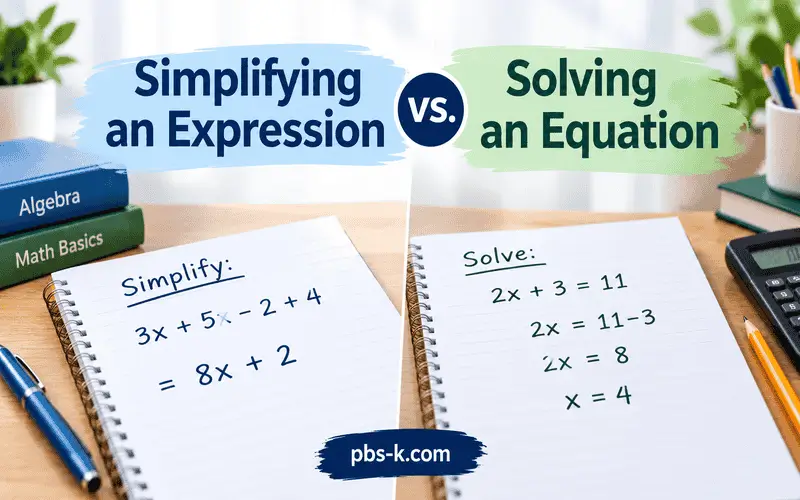
These two mathematical tasks are not the same.
Simplifying an expression means rewriting it in a shorter, equivalent form.
\[ 9x+8x-12+7=17x-5 \]
Solving an equation means finding a value of the variable that makes an equation true.
For example:
\[ 17x-5=29 \]
Add 5 to both sides:
\[ 17x=34 \]
Divide both sides by 17:
\[ x=2 \]
The original expression alone does not provide a unique value for \(x\). An equation or a specified value is needed for that.
Common Mistakes When Simplifying Algebraic Expressions
Even a short expression can lead to errors if you overlook a sign or combine terms incorrectly.
Adding Variables and Constants Together
You cannot combine \(17x\) and \(-5\) into a single like term. The first term contains a variable, while the second is a constant.
The correct simplified form is \(17x-5\), not \(12x\).
Ignoring the Negative Sign
The calculation \(-12+7\) equals \(-5\), not \(5\). When adding numbers with different signs, subtract their absolute values and keep the sign of the number with the greater absolute value.
Changing the Variable
The terms \(9x\) and \(8x\) combine to make \(17x\), not \(17x^2\). Adding variable terms does not introduce a new exponent.
Confusing Simplification With Evaluation
A calculator may require a value for \(x\) to calculate a numerical result. However, you can simplify the expression without knowing \(x\).
If a calculator asks for a value of \(x\), check whether you selected an evaluation function instead of an expression-simplification function.
When Should You Use a Fraction Calculator?
A fraction calculator is particularly helpful when working with fractions that are difficult to calculate mentally.
For example, when adding fractions with different denominators, you usually need to find a common denominator.
\[ \frac{1}{3}+\frac{1}{6} \]
Convert the first fraction to sixths:
\[ \frac{2}{6}+\frac{1}{6}=\frac{3}{6} \]
Reduce the result:
\[ \frac{3}{6}=\frac{1}{2} \]
A calculator can help check the arithmetic and simplify the final fraction.
Use an algebra calculator instead when you need to combine like terms, expand brackets, factor expressions, or solve equations. If you are studying both topics, practising the calculations manually before checking your result can help you understand the underlying rules.
Practice Problems for Beginners
Use the following examples to practise simplifying expressions before checking the answers.
| Expression | Simplified Answer |
|---|---|
| \(4x+3x+2\) | \(7x+2\) |
| \(6x+5x-4\) | \(11x-4\) |
| \(10x-3x+8-2\) | \(7x+6\) |
| \(7x+2x-9+4\) | \(9x-5\) |
| \(12x-5x-6+1\) | \(7x-5\) |
For each problem, group the variable terms, group the constants, and simplify each group separately.
If your answer differs from the table, check the signs and make sure you have combined only like terms.
Tips for Getting Better Results From Online Math Calculators
Follow these practical tips when checking your homework or practising algebra.
- Enter the expression carefully. Check every coefficient, variable, plus sign, and minus sign before calculating.
- Use clear multiplication notation. If the calculator requires
*, enter9*xrather than9x. - Choose the right operation. Simplifying an expression is different from solving an equation.
- Check the answer manually. A calculator result is most useful when you understand why it is correct.
- Use parentheses when needed. For more complex expressions, parentheses help show which operations belong together.
- Keep exact fractions when appropriate. If a fraction does not convert to a terminating decimal, a simplified fraction may be more useful than a rounded decimal.
These habits help reduce input errors and make it easier to understand your mathematical work.
Conclusion
The expression \(9x+8x-12+7\) simplifies to \(17x-5\). You can find the answer by adding the coefficients of the like variable terms and combining the constants separately.
A fraction calculator is useful for arithmetic involving fractions, while an algebra calculator is better suited to expressions containing variables. Choosing the right tool and checking each step helps you solve problems accurately and build stronger mathematical skills.
FAQs
What Is the Answer to 9x + 8x – 12 + 7?
The simplified answer is \(17x-5\). Add \(9x\) and \(8x\) to get \(17x\), then calculate \(-12+7=-5\).
Can a Fraction Calculator Simplify Algebraic Expressions?
Some calculators support both fractions and algebra, but others only perform numerical fraction operations. Choose an algebra calculator if you need to simplify expressions containing variables.
How Do You Combine Like Terms?
Combine terms that have the same variable part by adding or subtracting their coefficients. For example, \(4x+3x=7x\). Constants can also be combined with other constants.
Can You Find the Value of x From 17x – 5?
Not from the expression alone. You need a specified value for \(x\) or an equation to solve. For example, if \(17x-5=29\), then \(x=2\).
Why Is 9x + 8x Equal to 17x Instead of 17x²?
Both terms contain the same variable to the first power. You add their coefficients, \(9+8=17\), while keeping the variable unchanged. Multiplying the terms would be a different operation.
What Is the Difference Between a Fraction and an Algebraic Expression?
A fraction represents a number or quantity as a numerator divided by a denominator. An algebraic expression combines numbers, variables, and mathematical operations. An algebraic expression can also contain fractions, such as \(\frac{x}{2}+3\).
How Can I Check Whether My Simplified Answer Is Correct?
Combine like terms independently and compare your result with the calculator’s output. You can also substitute a test value for \(x\) into both the original and simplified expressions. If both produce the same result, that supports the correctness of the simplification.
Conclusion
The main takeaway is simple: \(9x+8x-12+7\) simplifies to \(17x-5\) because like terms can be combined without changing the expression’s value. Use a fraction calculator for fraction arithmetic and an algebra calculator for variable-based calculations. Practise the steps manually, then use a calculator to verify your results.
External Sources
Khan Academy, Combining Like Terms. Explains how to identify and combine terms that share the same variable part. Read the combining like terms lesson.
Khan Academy, Algebra Basics. Offers lessons and practice covering variables, algebraic expressions, combining like terms, and equivalent expressions. Explore algebra basics